


“There are always flowers for those who want to see them.” —
Henri Matisse
“The nation is shattered,” begins the poem Spring View, “but its rivers and mountains remain.”
Its author, the Tang dynasty poet Du Fu (712–770 CE), describes in this verse the turmoil that followed China’s bloody An Lushan Rebellion (755–763 CE), set against the cruel ambivalence of nature’s annual blossoming. “The flames of war have burned for three months,” Du Fu recounts. “Spring has come to the capital, and thick undergrowth buries it.” While birds sing and flowers bloom, millions suffer and palaces burn. More than 1,200 years after those words were first traced in black ink onto paper made from rattan and mulberry bark, the principle embodied in Du Fu’s verses continues to resonate today. Like China’s Sword of Goujian, these lines cut across distant latitudes and centuries of artistic and dynastic renewal: empires of power and knowledge may change, but landscapes endure.
To paraphrase the Chilean writer Benjamín Labatut, another, more recent gnomic author, reality does not exist independently of the act of observation. According to the history the South American writer unfolds in his books, scientists such as Niels Bohr and Werner Heisenberg repeatedly struggled to “deal with the paradoxes and contradictions [of science].” In When We Cease to Understand the World, Labatut constructs cautionary tales around scientific breakthroughs throughout history that proved to be double-edged swords. These include, for example, the invention of Prussian blue, which would later lead to Zyklon B, and the theory of relativity, which ultimately contributed to nuclear fission and the invention of the atomic bomb.
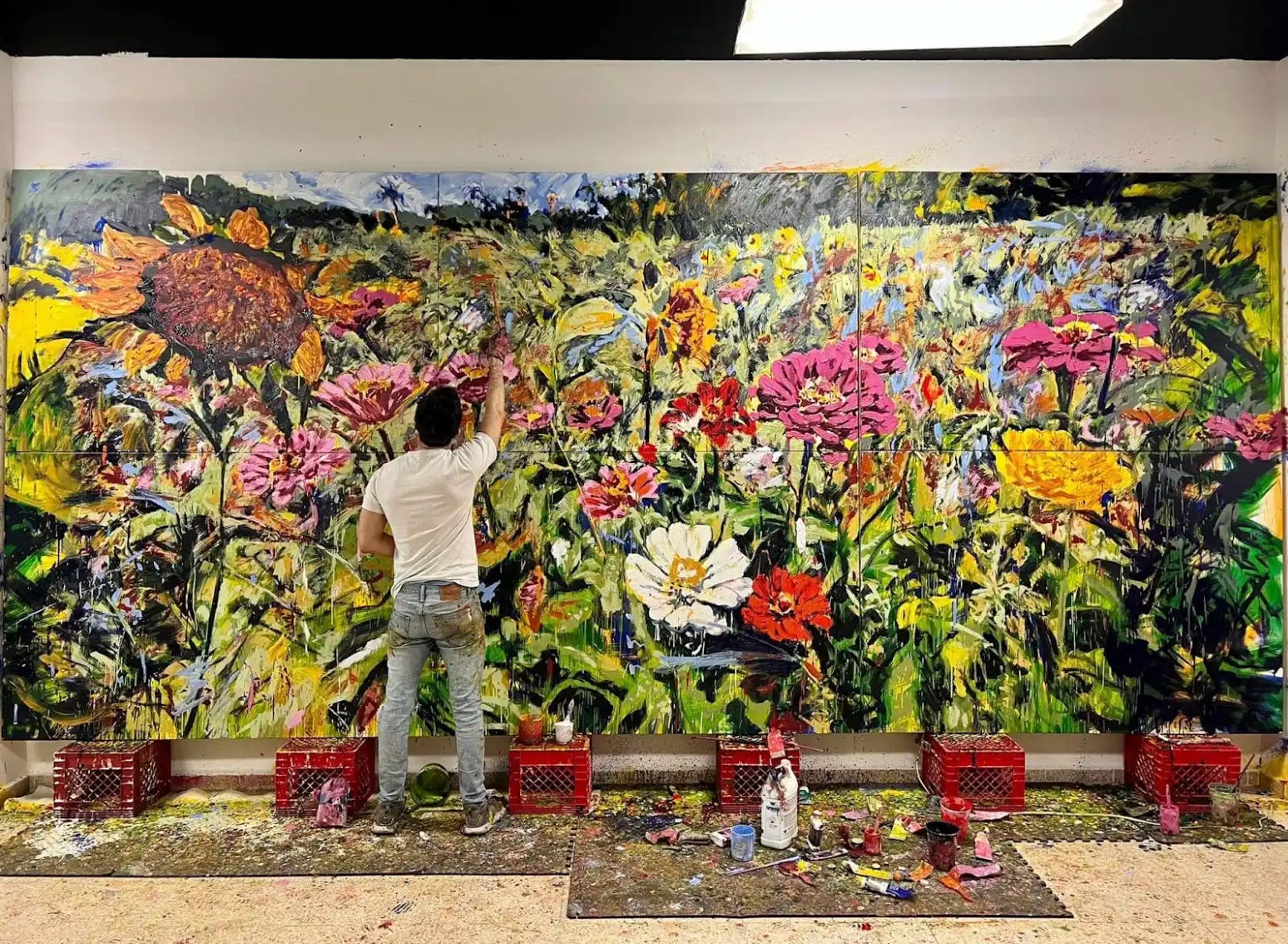
Un verdor terrible was published in English under the title When We Cease to Understand the World, although its literal translation would be A Terrible Greenness. Alluding to the recurring and horrifying vision suffered by chemist Fritz Haber—inventor of artificial fertilizers and mustard gas—of plants taking over the world, the phrase comes immediately to mind (as does Du Fu’s relentless poem) when looking at José Jun Martínez’s vigorously redemptive paintings of flowers.
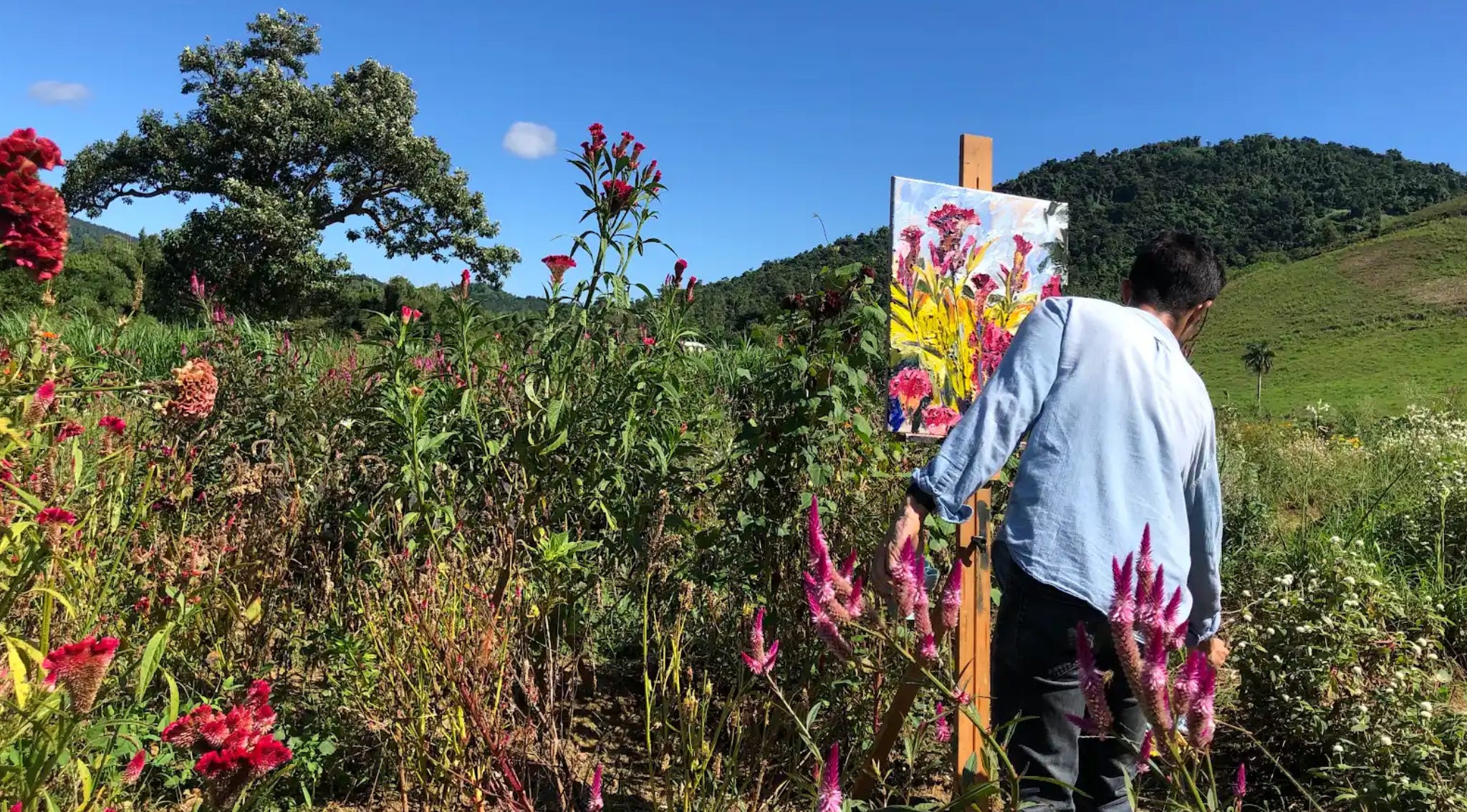
Martínez, a Puerto Rican-born and raised artist who trained at London’s Royal College of Art, has committed himself to a form of landscape painting that is stubbornly anachronistic and fiercely idiosyncratic. He creates heavily impastoed oil paintings, and his body of work feels at once resolutely traditional and passionately unusual. Like Du Fu’s poem, originally rendered in pictograms, Martínez’s paintings combine reflections on a broken country with a commitment to art as “an exercise in active contemplation.” The object of Martínez’s hyper-focused observation is Puerto Rico’s tropical flora, on an island ravaged by colonialism, corruption, and increasingly severe disasters brought about by climate change and political dysfunction.
If Martínez’s giant paintings of flowers—and trees and rivers—could speak, they would denounce the vulnerability of human-made systems. At the same time, they would proclaim the tenacity of nature and the measures by which that resilience might be understood. “A painter can say all he wants to with fruit or flowers, or even clouds,” Édouard Manet once told an interlocutor, illustrating the indifference that the artist regarded as the father of Impressionism felt toward the conventional hierarchy of genres. In the late nineteenth century, those hierarchies established the primacy of history painting—that is, classical, religious, mythological, and allegorical subjects—over every other subject rendered in oil, including scenes of everyday life, portraiture, still life, and landscape.
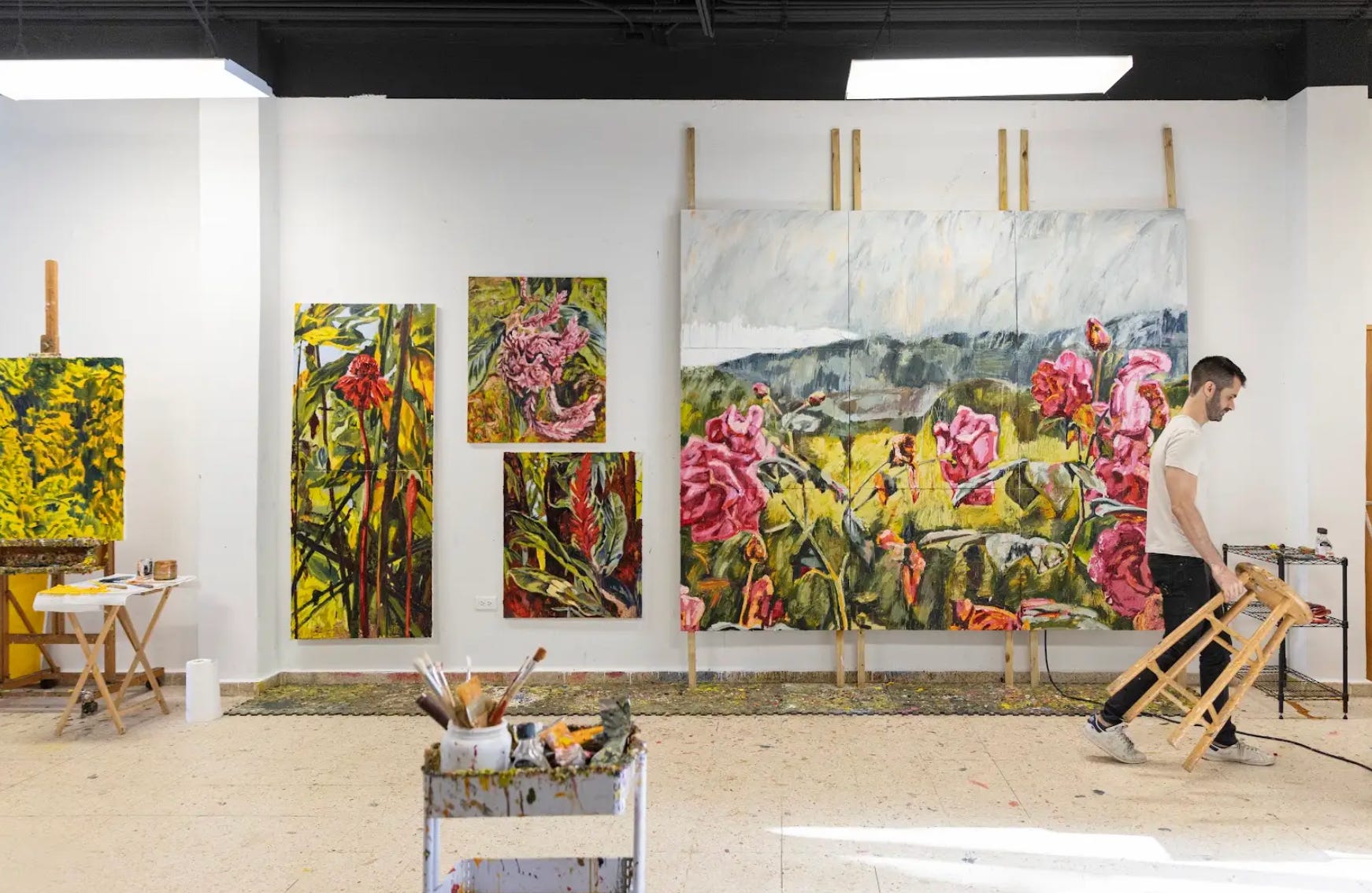
One hundred and fifty years later, these genres have mingled and multiplied promiscuously, largely in the service of conceptual approaches to art-making. For the young Martínez—he is 32—the act of painting constitutes both an affirmation of his “fields of flowers” and an aesthetic rebellion. In response to the world’s unreflective technophilia and what he calls the “individual and collective fatigue” of our time, his anthophilia—his love of flowers—offers a rigorous, swirling portrait of nature’s indomitable creativity, in the spirit of Vincent van Gogh.
“Considering everything we have lived through in recent years,” Martínez says of Puerto Rico, his homeland, “my artistic practice has led me to sow fields of flowers and weeds across my canvases.” From painting floral arrangements to “spending months visiting a farm in the El Yunque rainforest to paint flowers en plein air,” the artist has moved between studios in San Juan and London, expanding both the ambitions and the scale of his paintings.
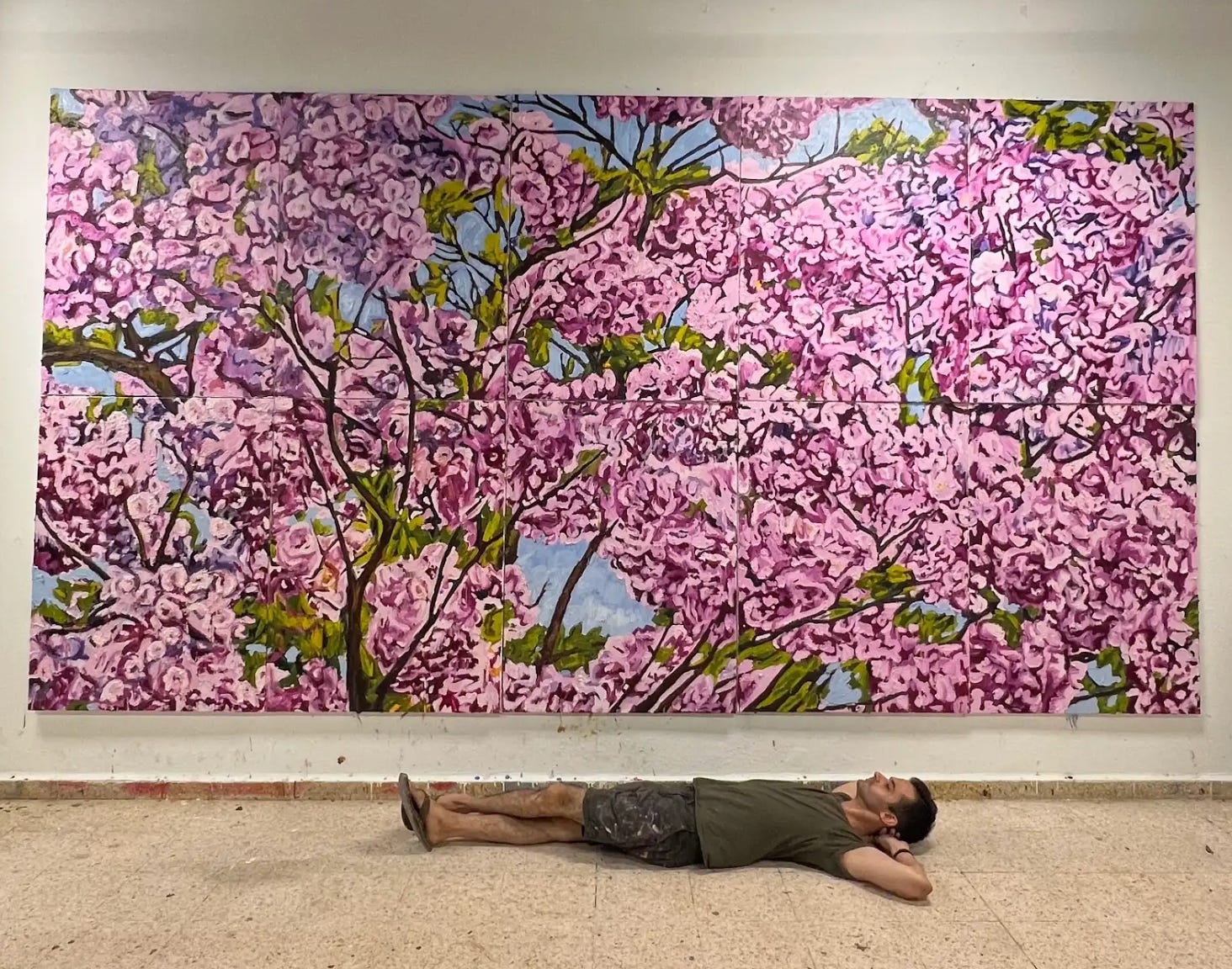
Consider El Abrazo de las Fieras (The Embrace of the Beasts, 2022) and Quince Segundos Antes de la Medianoche (Fifteen Seconds Before Midnight, 2023). The former depicts a field of wildflowers across an enormous eight-by-eight-foot canvas, like a wall in bloom. The latter presents the intensely yellow flowers of a flamboyant tree, a botanical transplant whose ability to withstand climatic events such as storms and hurricanes is legendary. Martínez’s golden spray also appears as a flower the size of a bear, as though the plant were rising onto its hind legs: a cosmic, enveloping presence, safeguarding life amid a recurring regime of disaster and embodying the regenerative force Martínez calls “dynamic hope.”
Flowers are a familiar and enduring subject throughout the history of Western art. In religious imagery, lilies symbolize the purity of the Virgin Mary. In Baroque vanitas paintings, cut flowers serve as stark reminders of mortality. Monet and Matisse turned to botanical subjects to explore the qualities of light and color.
The Surrealists introduced floral motifs into their investigations of dreams and metamorphosis. Georgia O’Keeffe used floral imagery in enlarged, almost abstract close-ups to draw the viewer’s gaze ever closer. Martínez, a thoroughly contemporary artist who uses painting—perhaps humanity’s most determined study of the visible—as a bastion against some of the world’s most intractable challenges, invokes this extensive history while appropriating the formal and symbolic potential of flowers as a vital force.
From Martínez’s blank canvases emerges a generative abundance that he has transformed into an artistic mission. The enormous petals, stigmas, and stamens in his compositions, which in turn form gigantic flowers, paradoxically answer a question he has posed in several public statements: “When everything passes, what remains?”
The answer, as embodied in his powerful paintings, echoes Du Fu: “The nation is shattered; the flowers and nature remain.”
Written by: Christian Viveros-Fauné has worked as a gallerist, art-fair director, art critic, and curator since 1994. He received Bucknell University’s Ekard Visiting Fellowship in 2023, the Kennedy Family Visiting Fellowship at the University of South Florida in 2018, a Creative Capital/Warhol Foundation grant in 2009, and was named critic-in-residence at the Bronx Museum in 2011.
He co-founded The Brooklyn Rail in 1999, wrote art criticism for the Village Voice from 2008 to 2016, and served as an art and culture critic for Artnet News from 2016 to 2018. He has lectured widely at institutions including Yale University, Pratt Institute, and the Gerrit Rietveld Academie in the Netherlands, and has curated exhibitions at major museums across the United States, Europe, and Latin America. He served as guest curator of the 2023 Converge 45 biennial in Portland, Oregon, and is currently curator-at-large at the University of South Florida Contemporary Art Museum.
He is the author of several books, including Greatest Hits: Art in New York, 2001–2015, published by CENDEAC. His most recent book, Social Forms: A Short History of Political Art, was published by David Zwirner Books in 2019.
El antófilo: El arte de José Jun Martínez
“Siempre hay flores para aquellos que quieren verlas” -
Henri Matisse
“La patria está quebrantada”, comienza el poema Contemplación primaveral, “mas permanecen sus ríos y montañas”.
El autor, el poeta Du Fu (712-770 d. C.), de la dinastía Tang, describe en este verso el tumulto que tuvo lugar tras la sangrienta rebelión china de An Lushan (755-63 d. C.) en medio de la cruel ambivalencia del florecimiento anual de la naturaleza. “Las llamas de la guerra han ardido tres meses seguidos”, relata Du Fu, “La primavera ha llegado a la capital, y espesas matas la sepultan.” Mientras los pájaros cantan y las flores florecen, millones de personas sufren y los palacios arden. Tras más de 1.200 años desde que se trazaran esas palabras con tinta negra sobre papel de ratán y corteza de morera, el principio que reflejan los versos de Du Fu sigue perdurando en la actualidad. Como la Espada de Goujian de China, estos versos traspasan latitudes lejanas y siglos de renovación artística y dinástica: los imperios del poder y del conocimiento varían, pero los paisajes son eternos.
Parafraseando al escritor chileno Benjamín Labatut, otro autor gnómico de cosecha más reciente, la realidad no existe como algo independiente del acto de la observación. Según la historia que este autor sudamericano refleja en sus libros, científicos como Neils Bohry Werner Heisenberg fracasaron repetidas veces a la hora de “lidiar con las paradojas y las contradicciones (de la ciencia)”. El autor de Un verdor terrible, Labatut, crea cuentos con moraleja sobre distintos avances científicos a lo largo de la historia que son un arma de doble filo. Por ejemplo, la invención del azul de Prusia, que más tarde derivó en el Zyklon B; y la teoría de la relatividad, que dio lugar a la fisión nuclear y a la invención de la bomba atómica.
La obra Un Verdor Terrible se ha publicado en inglés bajo el título When We Cease to Understand the World, siendo la traducción realmente “A Terrible Greenness”. Haciendo alusión a una visión recurrente y horrible de plantas apoderándose del mundo que sufría el químico Fritz Haber, inventor de los fertilizantes artificiales y del gas mostaza, la frase nos viene directamente a la mente (a la vez que el implacable poema de Du Fu) tal como vemos las pinturas de flores vigorosamente redentoras de José Jun Martínez.
Martínez, un artista formado en la Royal College of Art de Londres, nacido y criado en Puerto Rico, se ha comprometido con un tipo de paisajismo tenazmente anacrónico y ferozmente idiosincrático. Crea cuadros al óleo fuertemente empastados y su línea de trabajo resulta firmemente tradicional y apasionadamente inusual. Como el poema de Du Fu, originalmente plasmado en pictogramas, las pinturas de Martínez combinan las reflexiones sobre un país roto con un compromiso con el arte como “un ejercicio de contemplación activa”. El objeto de la observación hiperfocalizada de Martínez es la flora tropical de Puerto Rico, una isla destrozada por el colonialismo, la corrupción y el agravamiento de las catástrofes causadas por el cambio climático y la disfunción política.
Si los cuadros de flores gigantes (y árboles y ríos) de Martínez hablaran, denunciarían la vulnerabilidad de los sistemas creados por el hombre. De igual manera, proclamarían la tenacidad de la naturaleza y las métricas capaces de captar esa resiliencia. “Un pintor puede decir todo lo que quiera con frutas o flores, o incluso nubes” dijo Édouard Manet a un interlocutor para ilustrar la indiferencia que, el considerado padre del Impresionismo, mostraba por la convencional jerarquía de los géneros. A finales del siglo XIX, esas jerarquías formulaban la primacía de la pintura de historia (es decir, los temas clásicos, religiosos, mitológicos y alegóricos) sobre todos los demás temas pintados al óleo (escenas de la vida cotidiana, retratos, naturaleza muerta y paisajes).
Ciento cincuenta años después, dichos géneros se han mezclado y multiplicado promiscuamente, en gran medida al servicio de enfoques conceptuales de la creación artística. Para el joven Martínez (tiene 32 años), el acto de pintar constituye a la vez una afirmación de sus “campos de flores” y una rebeldía estética. Como respuesta a la tecnofilia irreflexiva del mundo y lo que denomina la “fatiga individual y colectiva” de nuestro tiempo, su antofilia (el amor por las flores) muestra un retrato riguroso y arremolinado de la indomable creatividad de la naturaleza, al estilo de Vincent van Gogh.
“Teniendo en cuenta todo lo que hemos vivido en los últimos años”, comenta Martínez sobre Puerto Rico, su país de origen, “mi práctica artística me ha llevado a sembrar campos de flores y maleza en mis lienzos.” Desde pintar cuadros de arreglos florales a “pasar meses visitando una finca en el bosque tropical El Yunque para retratar flores en plein air”, el artista se ha trasladado a estudios en San Juan y en Londres, lo que ha expandido tanto las expectativas como el tamaño de sus pinturas.
Analicemos los cuadros El Abrazo de las Fieras (2022) y Quince Segundos Antes de la Medianoche (2023). El primero muestra un campo de flores silvestres en un enorme lienzo de ocho por ocho, como si de una pared en flor se tratara; el segundo nos presenta las flores en un tono amarillo intenso de un flamboyán, un trasplante botánico cuya resistencia frente a fenómenos climáticos como tormentas y huracanes es legendaria. El golden spray de Martínez también se muestra como una flor del tamaño de un oso, como si la planta se alzara sobre sus patas traseras; una presencia cósmica y envolvente, garante de la vida en medio de un régimen regular de desastres y un símbolo de la fuerza regenerativa que Martínez denomina “esperanza dinámica”.
Las flores son un tema conocido y perdurable en la historia del arte occidental. En la imaginería religiosa, los lirios simbolizan la pureza de la Virgen María. En las pinturas vanitas del barroco, las flores cortadas son una cruda alusión a la mortalidad. Monet y Matisse recurrieron a temas botánicos para estudiar las cualidades de la luz y del color.
Los surrealistas introdujeron los motivos florales en su estudio de los sueños y la metamorfosis. Georgia O’Keeffe usó las imágenes florales en sus pinturas con primeros planos ampliados y casi abstractos para atraer aún más la mirada. Martínez, un artista completamente contemporáneo que utiliza la pintura (probablemente el estudio de lo visible más decidido de la historia de la humanidad) como bastión contra los retos más inextricables del mundo, evoca esta extensa historia, a la vez que se apropia del potencial formal y simbólico de las flores como fuerza vital.
De los lienzos en blanco de Martínez emerge una plenitud generativa que ha transformado en una misión artística. Los enormes pétalos, estigmas y estambres de sus composiciones que, a su vez, forman flores gigantes, responden paradójicamente a una pregunta que ha planteado en varias declaraciones públicas: “Cuando todo pasa, ¿qué perdura?” La respuesta, tal como se plasma en sus poderosas pinturas, se hace eco de Du Fu: “La patria está quebrantada, permanecen las flores y la naturaleza”.
Escrito por: Christian Viveros-Fauné ha trabajado como galerista, director de ferias de arte, crítico de arte y comisario desde 1994. Recibió la beca Ekard Visiting Fellowship de la Universidad Bucknell en 2023, la Kennedy Family Visiting Fellowship de la Universidad del Sur de Florida en 2018, una beca Creative Capital / Warhol Foundation en 2009 y fue nombrado crítico residente del Museo del Bronx en 2011.
Cofundó The Brooklyn Rail en 1999, escribió crítica de arte para Village Voice de 2008 a 2016 y fue crítico de arte y cultura para Artnet news de 2016 a 2018. Ha impartido numerosas conferencias en instituciones como la Universidad de Yale, la Universidad Pratt y la Gerrit Rietveld Academie de Holanda, y ha comisariado exposiciones en destacados museos de Estados Unidos, Europa y América Latina. Fue comisario invitado de la bienal Converge 45 2023 (Portland, OR) y actualmente es comisario general del Museo de Arte Contemporáneo de la Universidad del Sur de Florida. Es autor de varios libros, entre ellos Greatest Hits: Arte en Nueva York, 2001-2015, publicado por el CENDEAC. El más reciente, Social Forms: A Short History of Political Art, ha sido publicado por David Zwirner Books en 2019.