


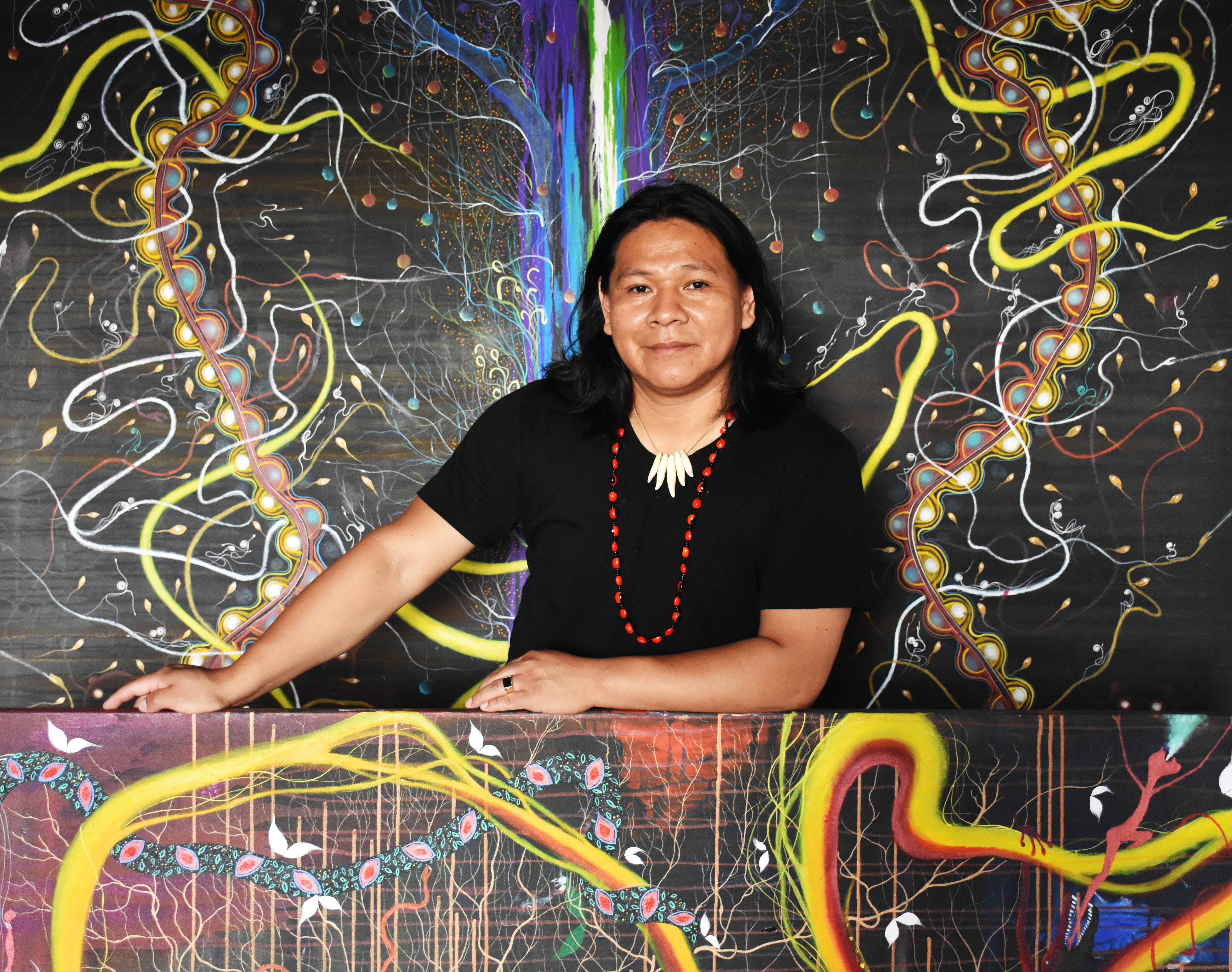
Rember Yahuarcani is a painter, writer, curator, and activist. His work has emerged as one of the most powerful voices for thinking about the Amazon from within, as a territory shaped by memory and knowledge. In recent years, his practice has gained strong international visibility, including his participation in Foreigners Everywhere at the 60th Venice Biennale.
In this interview, Rember takes us back to his beginnings: Pebas, his family, collaborative work, and the materials that have defined his practice. He also reflects on how, in his work, myth operates as a living truth: knowledge passed down from his grandparents, where the beings, gods, and stories that appear in his paintings are rooted in a memory that remains present.
How did your relationship with painting begin, and what role did your family play in that learning?
RY: For a long time, my family was engaged in various forms of artisanal work. I grew up making objects for tourists: souvenirs, paintings of animals and landscapes, carvings, necklaces, ceramics, traditional objects. My grandmother, my grandfathers, my father, my mother… It was collective work, family work.
I was born and lived in Pebas. Years ago it was a very small town. In the community, people live off the chacra, fishing, agriculture, hunting. In parallel, we did handicrafts because it gave us income to buy basic things: uniforms, school supplies, etc. There was no “specialization”: we all did everything.
At what point did painting become the center of your practice?
RY: The specialization in painting comes starting in the 2000s, when my father, Santiago Yahuarcani, began to feel the need to show his works.
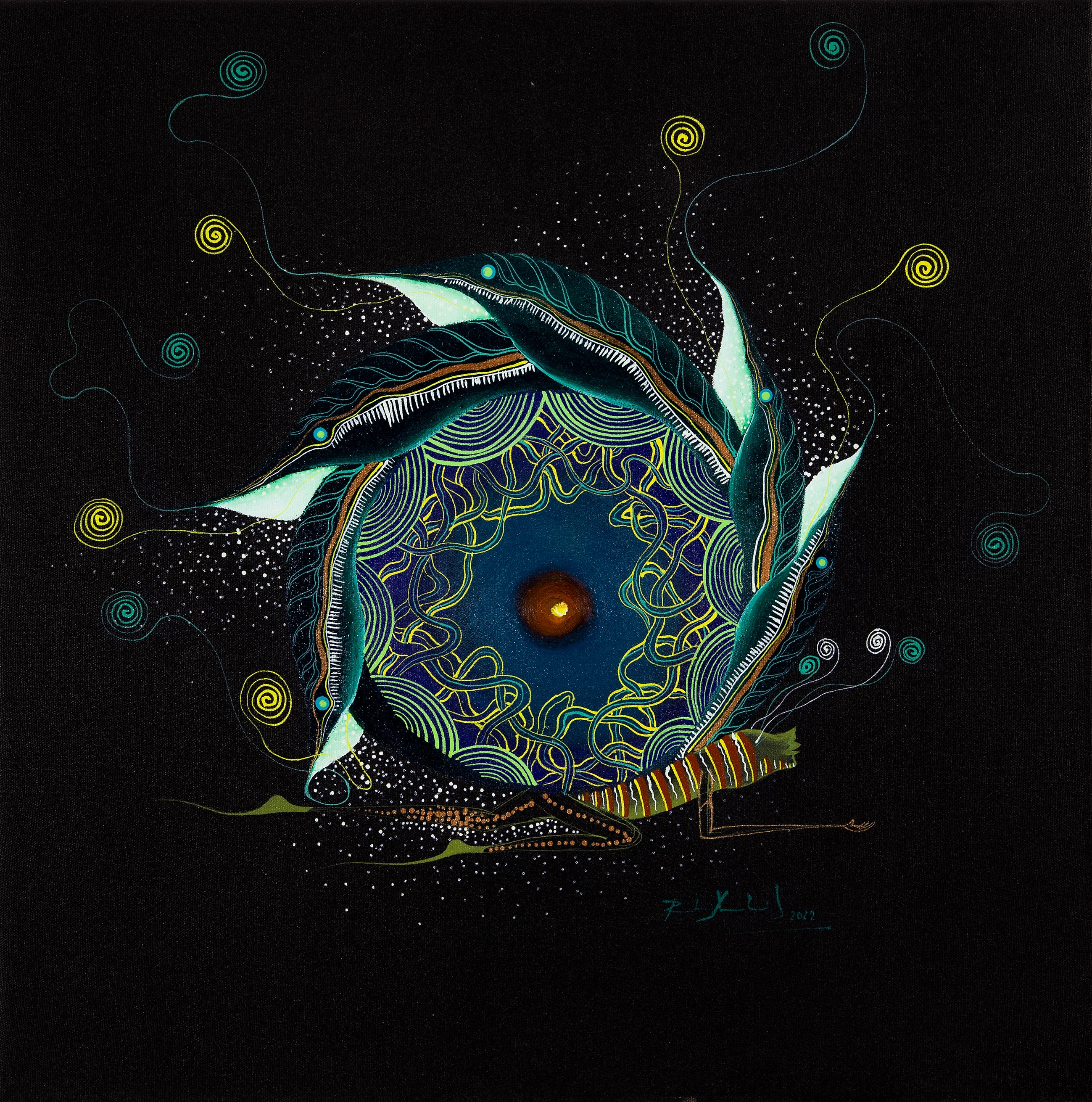
In that process, painting became shared work. Many works at that time were collaborations: some are even signed by me, because I did an important part: sometimes 40%, sometimes 70%. Sometimes, for example, my father painted more of the characters, and I filled in around them: plants, leaves, trees, the surroundings. Over time, a more distinct sense of separate authorship emerged.
"… my father painted more of the characters, and I filled in around them: plants, leaves, trees, the surroundings. Over time, a more distinct sense of separate authorship emerged.”
Your first solo show was at the National Library of Peru. How did you get to that moment?
RY: In 2003, there was a major exhibition called Serpiente de Agua: La vida indígena en la amazonía (Water Serpent: Indigenous Life in the Amazon), with several sections and institutions involved. My father was invited not by the main curatorship, but by the Ministry of Foreign Trade and Tourism, through the National Directorate of Handicrafts, which selected artisans from different regions.
I had just finished school and my father suggested that I travel to Lima on his behalf. That’s how I traveled with his works and my works: not only painting, but also fiber dolls, masks, sculptures—a range of things.
A key encounter happens there: the Director of Intangible Heritage at the National Library sees the llanchama I brought, a plant-based textile obtained from the bark of the renaco that I use as a canvas, and she is surprised. She invites me to visit the Library and proposes that I do an exhibition there. I accepted, and in September 2004 we opened my first solo show at the National Library.

Tell us about your practice: different myths and beings appear in your work. Which figures and stories recur throughout your work?
RY: For me, myth is absolute truth. Just as for a Catholic the Bible is truth, for me myth is truth. I grew up with that: the gods that appear in the paintings are not an invention.
When you are in the jungle with your grandfather or grandmother, and they tell you, “this tree used to be a man who didn’t obey and that’s why he turned into a tree,” in that moment the myth becomes material: you are seeing it, you are touching it. That is alive. That’s why, in my work, characters appear such as the Hummingbird Man, Jitoma, the Sun God: they are myths I heard as a child and that struck me. I imagined them as if they were walking through the forest.
In the Uitoto world there are three versions of the creation of the world and all three are true. In one, the first humans come out from deep inside the earth: they do not have the form we have now; they are frogs, fish, leaves, beings with membranes, tails. They come out on a stormy night, through an opening made by the first man, Monaduta, with a blowgun.
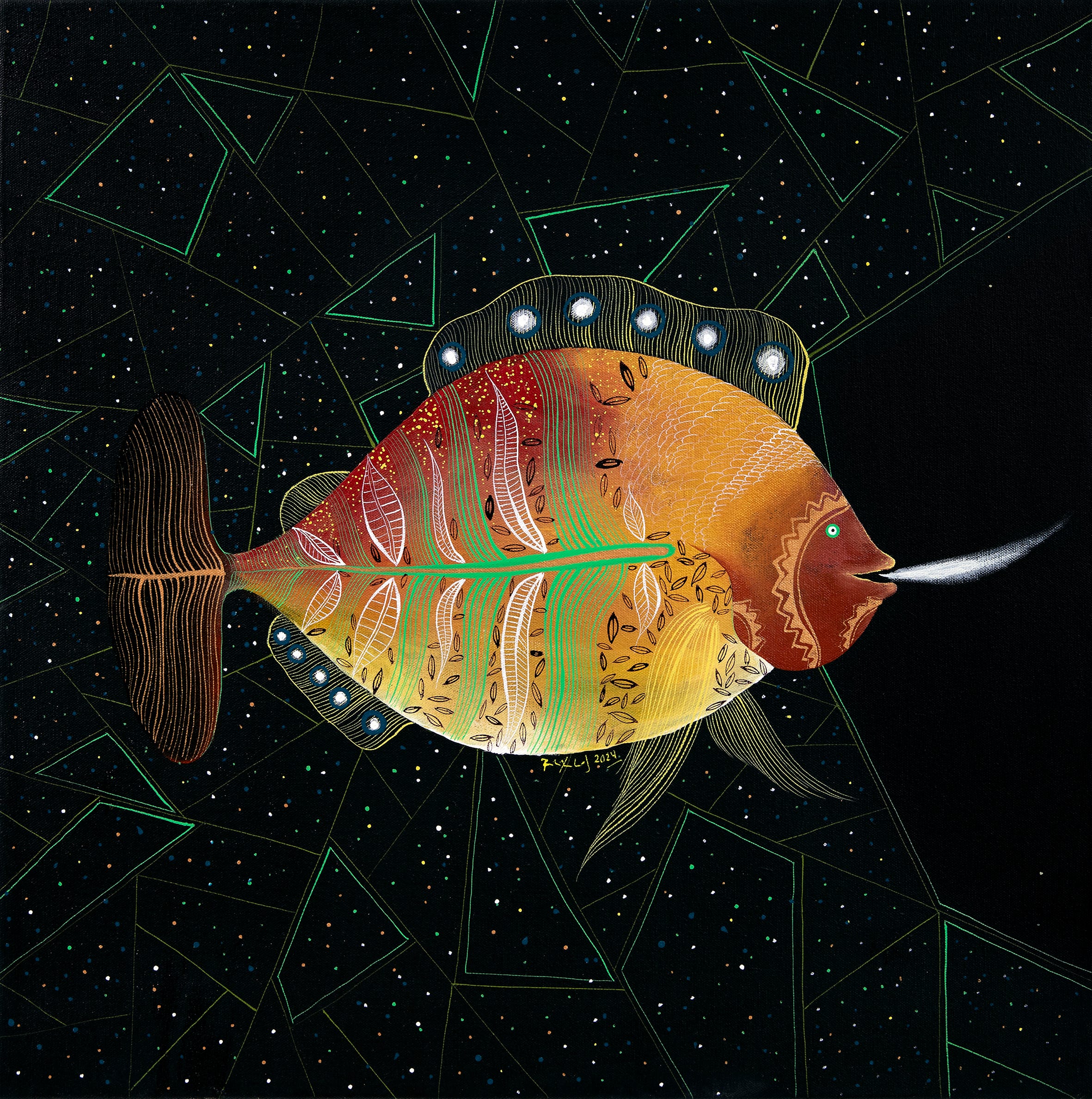
So when someone sees a snake that speaks, a fish that walks, a canoe with legs, they are not seeing an “invention”: they are seeing the manifestation of those first human forms, according to my grandparents. I have absolute faith in what my grandmother told me, and that’s why the hummingbird, the frog man, the fish repeat. They are all beings that marked me.
“For me, myth is absolute truth.”
In recent years there has been a surge of interest in art from the Amazon and in Indigenous artists in the international circuit, as can be seen in the case of Sara Flores. What’s your perspective on this?
RY: It’s difficult to respond without context. In Peru, over the last 20 years there has been a boom in the visibility of art made by Indigenous artists, but labeled as “Amazonian art.” Both my father and our clan, we are the Garza Blanca clan, have stayed on the margins, because we consider that this visibility has generated a new extractivism.
Here it is important to ask: what is the difference between “Amazonian” and “Indigenous”? In the Amazon, with the rubber boom at the beginning of the 20th century, there was European and North American migration toward Iquitos (and also Manaus). Those people developed economic power, political power, power over transportation, over social life. They begin to build a narrative: they stop being migrants and define themselves as “Amazonian.” They occupy Indigenous territory without asking permission, and their descendants inherit privilege: they study in Lima, inherit capital, and that power expands into literature, academia, and the arts. For decades they have spoken on our behalf, they have built power, and when someone steps outside that structure, it makes people uncomfortable.
The point is that a representation of the Amazon is constructed in which the Indigenous person does not participate. In 1943, for example, one of the first major exhibitions about the Amazon in Peru is held and there are no Indigenous people: it is Limeño mestizos speaking about the Amazon. That drags on for decades. When you read “Amazonian literature,” many times you don’t find Indigenous authors, but the content is full of appropriated Indigenous knowledge. The same happens with “Amazonian art”: people speak about the Indigenous person without listening to their voice, and a category is installed that absorbs everything.
In the case of Sara Flores, her selection to represent Peru at the Venice Biennale this year is extremely important. Besides being an Indigenous artist, she is an Indigenous grandmother: there is a wisdom there that goes beyond a geometry or a line. That presence can make the history of exclusion visible: Indigenous peoples who have remained on the margins of decisions of power and officialdom.

When your work enters an art fair, an institution, or a gallery, what conditions do you consider essential for it to be presented with rigor?
RY: I’m not going to fall into romanticism. My work is born from Indigenous knowledge and we come from a history with tremendous violence, but when a work is shown at an art fair it enters the market: it becomes an object and it has a price. That is real.
However, I will always seek care and clarity. My work has several facets: there is memory, there is ancestral aesthetics, but there is also knowledge kept for hundreds of years. That also implies deciding where it is presented and which discourse is validated.
I reject exhibitions that seek to read my work from a “shamanic” context. I don’t want my painting to be read as something exotic or to be pigeonholed as an “object of study”; I don’t want to validate academic discourses from that place. I want my work to be treated with rigor: to enter those difficult spaces of contemporary art where the work is judged by its proposal, its aesthetic quality, its concept, its process, and its weight. I want it to compete on equal terms.
I want my work to be treated with rigor: to enter those difficult spaces of contemporary art where the work is judged by its proposal ... I want it to compete on equal terms.
You have participated in biennials and in institutional spaces. What do you want the public to understand when they see your work in those contexts?
RY: I want them to understand that our voice has been silenced for more than 100 or 200 years in Peru. Our voice was kidnapped: others spoke for us.
Art is one of the few disciplines that has given us the possibility of speaking in the first person. Anthropology treated us as an object of study; ethnography often placed us almost as part of the natural environment; history also left us out. But art breaks that: in front of a painting, a work is judged as such. And in that act, the Indigenous person can speak directly, without a translator. Even if their Spanish is not perfect, that is not the central thing: the central thing is what it communicates.
Of course, that rupture makes uncomfortable those who have spoken for us for a long time, and who have benefited from that. That’s why I speak plainly: we need debate. Because in this process there are losers, and the losers are Indigenous people.
“Anthropology treated us as an object of study; ethnography often placed us almost as part of the natural environment ... But art breaks that: in front of a painting, a work is judged as such. And in that act, the Indigenous person can speak directly, without a translator.”
In those circuits, what interpretations or ideas do you think it is important to question?
RY: The normalization of concepts. The normalization that the Indigenous person, in order to mount an exhibition, “needs” a specialist. The normalization that all artistic production in the Amazon is “Amazonian art,” when in the Amazon there is Indigenous art, traditional, visionary, Amazonian, urban… Imposing a single label on everything is a form of neocolonialism.
Also the idea that the Indigenous person cannot make decisions about their future or raise their voice. As long as the Indigenous person does not protest and does not make trouble, it’s fine. But when they demand rights or what belongs to them, they become “uncomfortable” for the State, politics, academia, contemporary art. And there is also the normalization that others speak for us. That continues to happen.
Looking at your latest works, what direction is your practice moving in?
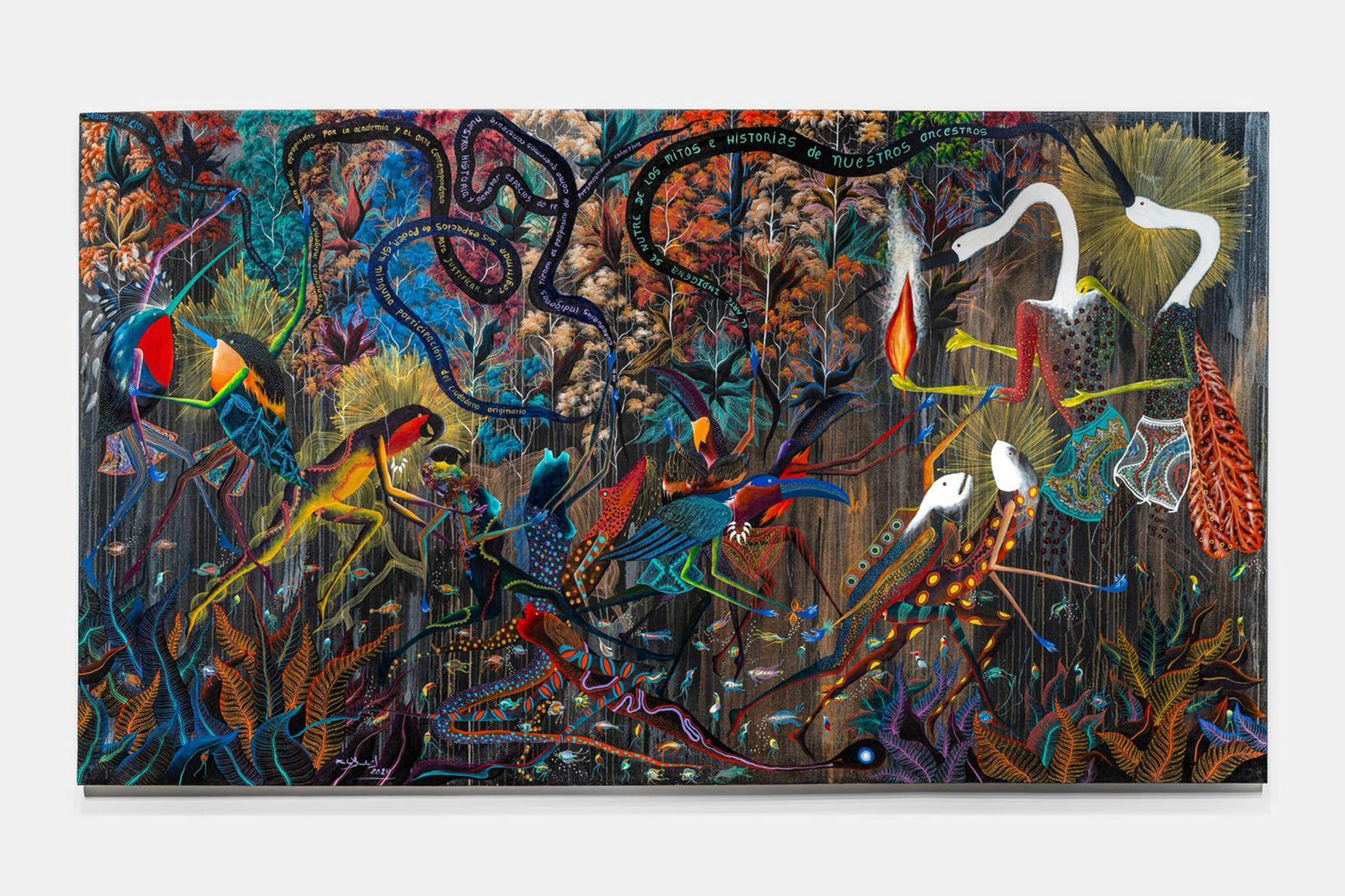
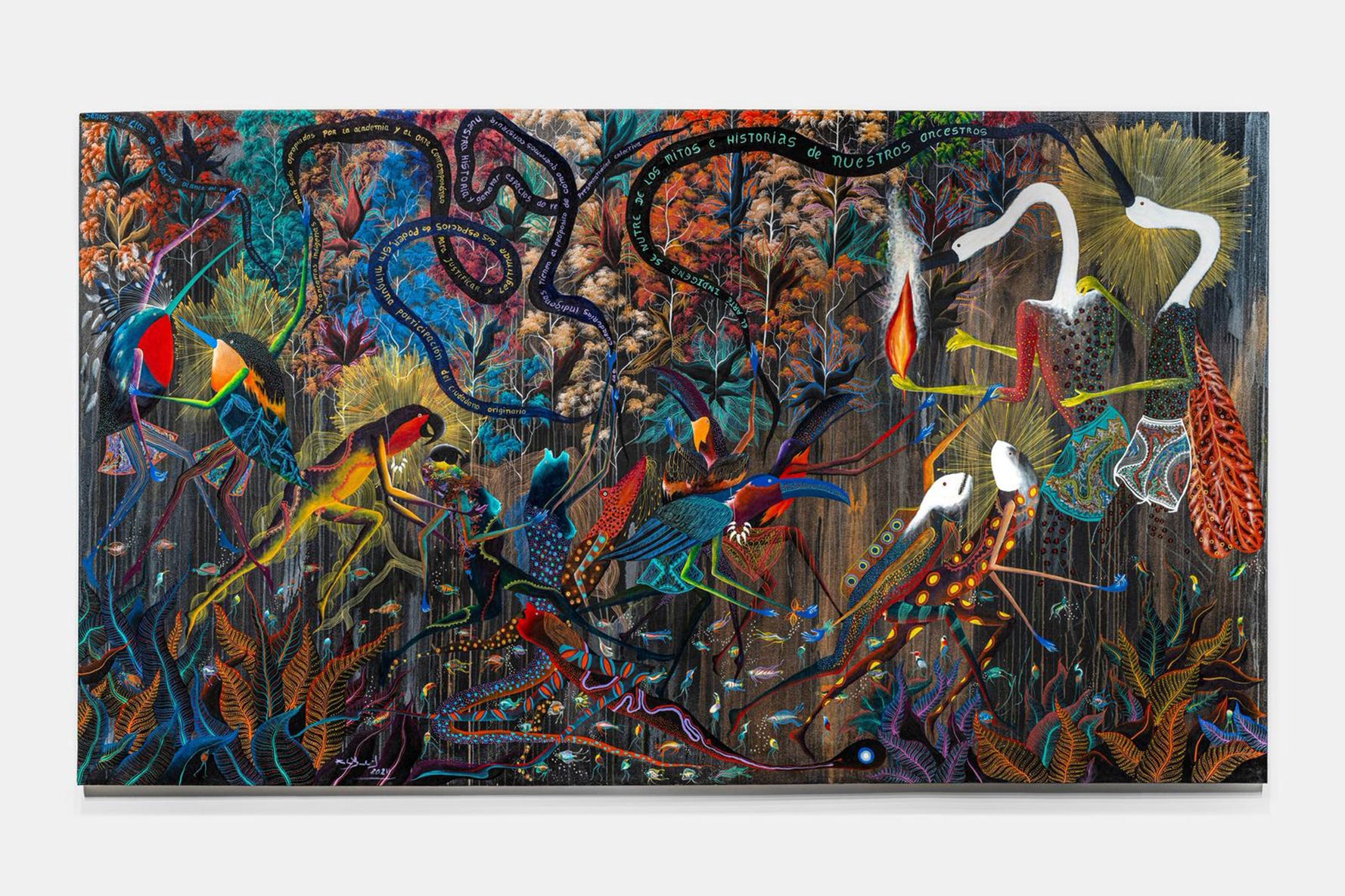
RY: I’m moving toward a more activist work. My recent works include long texts. I’m painting a large work, almost three meters, called Dioses Uitotos exiliados. The Garza Man appears there holding a long text where our history and the relationship with the West can be read.
The aesthetic is not lost, but the text comes in more strongly: it’s a way of working the content more directly.
What are you seeking to generate with your work? Political, social, environmental change?
RY: I’m seeking for Indigenous people to have a more active participation in spaces that have been denied to them, or spaces that belong to them. That institutions do not include us only “for the photo” or “for the video,” but that a participation is truly activated, as agents of change.
I also seek for us to stop being treated as third-class people. That our work have the value it should have, like any work by any contemporary artist. My work seeks reflection, and it seeks change in society, definitely.
“I’m seeking for Indigenous people to have a more active participation in spaces that have been denied to them, or spaces that belong to them.”
To learn more about Rember Yahuarcani, visit:
En el estudio con: Rember Yahuarcani
Rember Yahuarcani es pintor, escritor, curador y activista. Su obra se ha convertido en una de las voces más potentes para pensar la Amazonía desde adentro, como un territorio de memoria y conocimiento. En los últimos años, su trabajo ha circulado con fuerza en el circuito internacional, incluida su participación en Foreigners Everywhere en la 60ª Bienal de Venecia.
En esta entrevista, Rember nos conduce de regreso a sus comienzos: Pebas, su familia, el trabajo en colaboración y los materiales que han definido su práctica. También reflexiona sobre cómo, en su obra, el mito funciona como una verdad viva: un conocimiento heredado de sus abuelos, donde los seres, dioses e historias que aparecen en sus pinturas se anclan en una memoria que sigue presente.
¿Cómo nace tu relación con la pintura, y qué lugar tuvo tu familia en ese aprendizaje?
RY: Mi familia se dedicó durante muchísimo tiempo a ciertos trabajos artesanales. Crecí haciendo objetos para turistas: souvenirs, pinturas de animales y paisajes, tallados, collares, cerámica, objetos tradicionales. Mi abuela, mis abuelos, mi papá, mi mamá… Era un trabajo en conjunto, familiar.
Yo nací y viví en Pebas. Hace años era un pueblo muy pequeño. En la comunidad se vive de la chacra, la pesca, la agricultura, la caza. Paralelamente, nosotros hacíamos artesanía porque nos daba ingresos para comprar cosas básicas: uniformes, útiles del colegio, etc. No había una “especialización”: todos hacíamos de todo.
¿En qué punto la pintura se volvió el centro de tu práctica?
RY: La especialización en pintura llega a partir de los años 2000, cuando mi padre, Santiago Yahuarcani, empezó a tener la necesidad de mostrar sus obras.
En ese proceso, la pintura se volvió un trabajo compartido. Muchas obras en ese tiempo fueron colaboraciones: incluso algunas están firmadas por mí, porque yo hacía una parte importante, a veces el 40%, a veces 70%. A veces, por ejemplo, mi padre pintaba más a los personajes, y yo llenaba alrededor: plantas, hojas, árboles, el entorno. Recién con el tiempo se fue definiendo con claridad una autoría más separada.
"… mi padre pintaba más a los personajes, y yo llenaba alrededor: plantas, hojas, árboles, el entorno. Recién con el tiempo se fue definiendo con claridad una autoría más separada.”
Tu primera muestra individual fue en la Biblioteca Nacional del Perú. ¿Cómo llegas a ese momento?
RY: En 2003, hubo una gran exposición llamada Serpiente de Agua: La vida indígena en la amazonía, con varias secciones y varias instituciones involucradas. A mi padre lo invitan no desde la curaduría principal, sino desde el Ministerio de Comercio Exterior y Turismo, a través de la Dirección Nacional de Artesanía, que seleccionaba artesanos de distintas regiones.
Yo acababa de terminar el colegio y mi padre me sugirió viajar a Lima en representación suya. Fue así como yo viajé con obras de él y obras mías: no solo pintura, también muñecas en fibra, máscaras, esculturas, una diversidad de cosas.
Ahí se genera un encuentro clave: la directora de Patrimonio Inmaterial de la Biblioteca Nacional ve la llanchama que yo llevé, un tejido vegetal obtenido de la corteza del renaco que yo uso como lienzo, y se sorprende. Me invita a conocer la Biblioteca y me propone hacer una muestra ahí. Yo acepté, y en septiembre de 2004 inauguramos mi primera muestra individual en la Biblioteca Nacional.
Cuéntanos sobre tu práctica: en tu obra aparecen distintos mitos y seres. ¿Qué figuras e historias se repiten a lo largo de tu trabajo?
RY: Para mí el mito es la verdad absoluta. Así como para un católico la Biblia es verdad, para mí el mito es verdad. Yo crecí con eso: los dioses que aparecen en la pintura no son una invención.
Cuando uno está en la selva con el abuelo o la abuela, y te dicen: “este árbol fue un hombre que no obedeció y por eso se convirtió en árbol”, en ese momento el mito se vuelve material: lo estás viendo, lo estás tocando. Eso está vivo. Por eso, en mi obra aparecen personajes como el Hombre Picaflor, Jitoma, el Dios Sol: son mitos que escuché de niño y que me impactaron. Yo los visualizaba como si caminaran por el bosque.
En el mundo Uitoto hay tres versiones de la creación del mundo y las tres son verdaderas. En una, los primeros humanos salen del fondo de la tierra: no tienen la forma que tenemos ahora, son ranas, peces, hojas, seres con membranas, colas. Salen en una noche tormentosa, por una abertura que hace el primer hombre, Monaduta, con una cerbatana.
Entonces cuando alguien ve una serpiente que habla, un pez que camina, una canoa con piernas, no está viendo una “invención”: está viendo la manifestación de esas primeras formas humanas, según mis abuelos. Yo tengo fe absoluta en lo que me dijo mi abuela, y por eso se repiten el picaflor, el hombre rana, los peces. Todos son seres que me marcaron.
“Para mí el mito es la verdad absoluta.”
En los últimos años hay un auge de interés por el arte proveniente de la Amazonía y por artistas indígenas en el circuito internacional, como se aprecia en el caso de Sara Flores. ¿Qué opinas al respecto?
RY: Es difícil responder sin contexto. En Perú, en los últimos 20 años ha habido un boom de visibilización del arte hecho por artistas indígenas, pero etiquetado como “arte amazónico”. Tanto mi padre como nuestro clan, nosotros somos el clan de la Garza Blanca, nos hemos mantenido al margen, porque consideramos que esa visibilización ha generado un nuevo extractivismo.
Ahí es importante preguntar: ¿qué diferencia hay entre “amazónico” e “indígena”? En la Amazonía, con el boom del caucho a inicios del siglo XX, hubo una migración europea y norteamericana hacia Iquitos (y también Manaus). Esas personas desarrollan poder económico, poder político, poder sobre el transporte, sobre la vida social. Empiezan a construir una narrativa: dejan de ser migrantes y se autodefinen como “amazónicos”. Ocupan territorio indígena sin pedir permiso, y sus descendientes heredan privilegio: estudian en Lima, heredan capital, y ese poder se expande a la literatura, la academia, las artes. Durante décadas han hablado en nombre de nosotros, han construido poder, y cuando alguien se sale de esa estructura, incomoda.
El punto es que se construye una representación de la Amazonía donde el indígena no participa. En 1943, por ejemplo, se hace una de las primeras grandes exposiciones sobre la Amazonía en el Perú y no hay ningún indígena: son mestizos limeños hablando sobre la Amazonía. Eso se arrastra por décadas. Cuando tú lees “literatura amazónica”, muchas veces no encuentras autores indígenas, pero el contenido está lleno de conocimiento indígena apropiado. Lo mismo pasa con el “arte amazónico”: se habla del indígena sin escuchar su voz, y se instala una categoría que lo absorbe todo.
En el caso de Sara Flores, su selección para representar al Perú en la Bienal de Venecia este año es importantísima. Además de ser una artista indígena, es una abuela indígena: hay una sabiduría ahí que va más allá de una geometría o una línea. Esa presencia puede dejar en evidencia la historia de exclusión: pueblos indígenas que han estado al margen de decisiones de poder y de la oficialidad.
Cuando tu obra entra a una feria, una institución o una galería, ¿qué condiciones consideras esenciales para que se presente con rigor?
RY: No voy a caer en romanticismos. Mi obra nace de un conocimiento indígena y venimos de una historia con muchísima violencia, pero cuando una obra se expone en una feria de arte entra al mercado: se vuelve objeto y tiene un precio. Eso es real.
Sin embargo, yo siempre buscaré cuidado y claridad. Mi obra tiene varias aristas: hay memoria, hay estética ancestral, pero también hay conocimiento guardado de cientos de años. Eso también implica decidir dónde se presenta y qué discurso se valida.
Yo rechazo muestras que buscan leer mi obra desde un contexto “chamánico.” No quiero que mi pintura se lea como algo exótico o sea encasillada como “objeto de estudio”, no quiero validar los discursos de la academia desde ese lugar. Yo quiero que mi obra sea tratada con rigor: que entre a esos espacios difíciles del arte contemporáneo donde la obra se juzga por su propuesta, su calidad estética, su concepto, su proceso y su peso. Quiero que compita en igualdad de condiciones.
“Yo quiero que mi obra sea tratada con rigor: que entre a esos espacios difíciles del arte contemporáneo donde la obra se juzga por su propuesta ... Quiero que compita en igualdad de condiciones.”
Has participado en bienales y en espacios institucionales. ¿Qué te interesa que el público entienda cuando ve tu obra en esos contextos?
RY: Quiero que entiendan que nuestra voz ha sido callada por más de 100 o 200 años en el Perú. Nuestra voz fue secuestrada: hablaron otros por nosotros.
El arte es una de las pocas disciplinas que nos ha dado la posibilidad de hablar en primera persona. La antropología nos trató como objeto de estudio; la etnografía muchas veces nos colocó casi como parte del entorno natural; la historia también nos dejó afuera. Pero el arte rompe eso: frente a una pintura, una obra se juzga como obra. Y en ese acto, el indígena puede hablar de frente, sin traductor. Incluso si su español no es perfecto, eso no es lo central: lo central es lo que comunica.
Claro, ese quiebre incomoda a quienes han hablado por nosotros durante mucho tiempo, y se han beneficiado de eso. Por eso yo digo las cosas claras: necesitamos debate. Porque en este proceso hay perdedores, y los perdedores son los indígenas.
“La antropología nos trató como objeto de estudio; la etnografía muchas veces nos colocó casi como parte del entorno natural … Pero el arte rompe eso: frente a una pintura, una obra se juzga como tal. Y en ese acto, el indígena puede hablar de frente, sin traductor.”
En esos circuitos, ¿qué interpretaciones o ideas te parecen importante cuestionar?
RY: La normalización de conceptos. La normalización de que el indígena, para hacer una muestra, “necesita” un especialista. La normalización de que toda producción artística en la Amazonía es “arte amazónico”, cuando en la Amazonía hay arte indígena, tradicional, visionario, amazónico, urbano… Imponer una sola etiqueta sobre todo es una forma de neocolonialismo.
También la idea de que el indígena no puede tomar decisiones sobre su futuro o alzar la voz. Mientras el indígena no proteste y no incomode, está bien. Pero cuando exige derechos o lo que le pertenece, se vuelve “incómodo” para el Estado, la política, la academia, el arte contemporáneo. Y también está la normalización de que otros hablen por nosotros. Eso sigue pasando.
Al mirar tus obras más recientes, ¿hacia qué dirección está evolucionando tu práctica?
RY: Estoy yendo hacia una obra más activista. Mis obras recientes incluyen textos largos. Estoy pintando una obra grande, casi de tres metros, que se llama Dioses Uitotos exiliados. Ahí aparece el Hombre Garza sosteniendo un texto largo donde se lee nuestra historia y la relación con Occidente.
No se pierde lo estético, pero el texto entra con más fuerza: es una manera de trabajar el contenido de forma más directa.
¿Qué buscas generar con tu obra? ¿Un cambio político, social, ambiental?
RY: Busco que los indígenas tengan una participación más activa en espacios que les han sido negados, o espacios que les pertenecen. Que las instituciones no nos incluyan solo “para la foto” o “para el video”, sino que realmente se active una participación como agentes de cambio.
También busco que dejemos de ser tratados como personas de tercera categoría. Que nuestra obra tenga el valor que debe tener, como cualquier obra de cualquier artista contemporáneo. Mi obra busca reflexión, y busca cambio en la sociedad, definitivamente.
“Busco que los indígenas tengan una participación más activa en espacios que les han sido negados, o espacios que les pertenecen.”
Para saber más sobre Rember Yahuarcani, visita: