


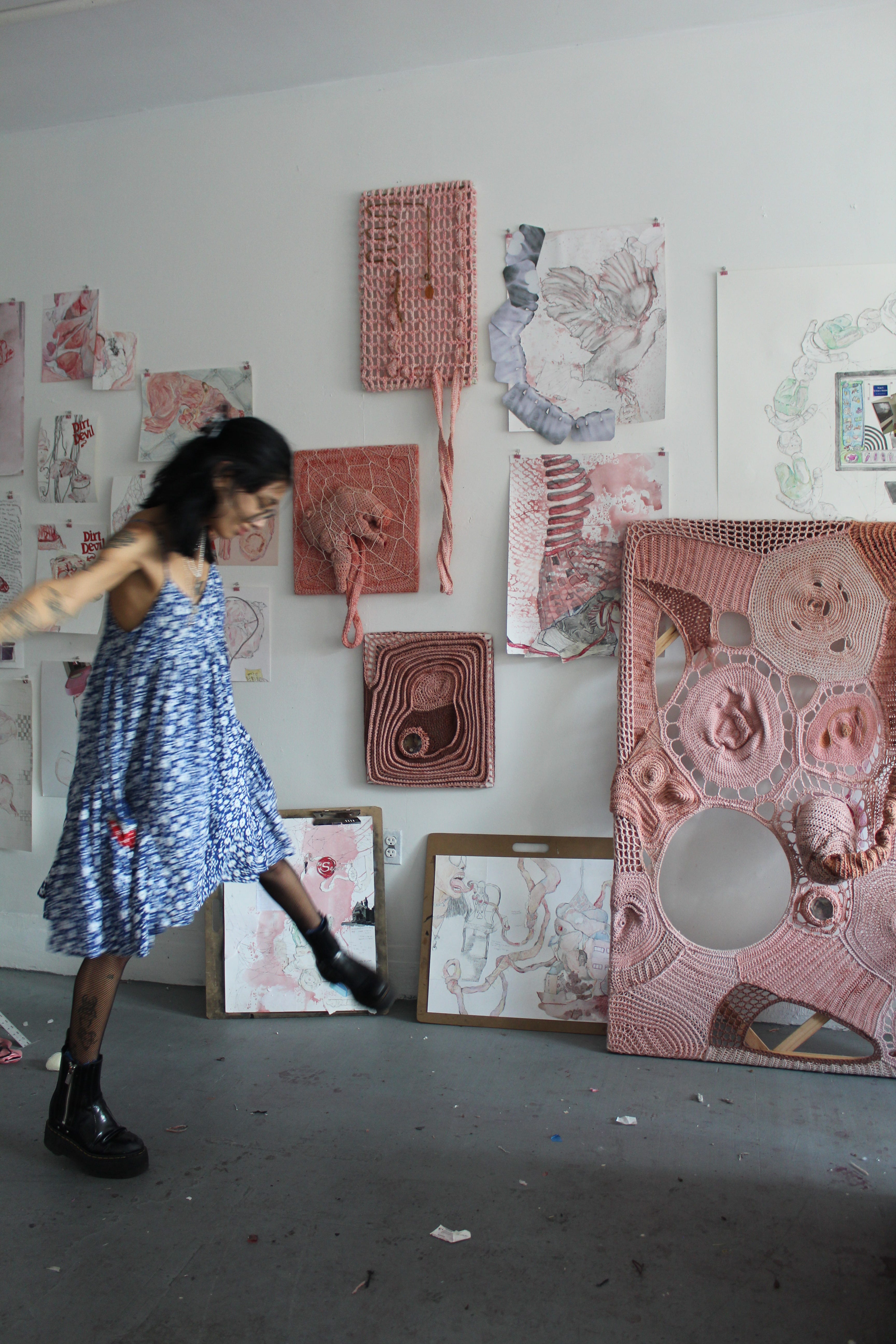

Ophelia Arc is a research based multidisciplinary artist with Chilean and Peruvian roots, currently residing in Providence, USA. As she completes her final year of studies, she is already making a significant impact in the art scene, having showcased her first solo exhibition at an art gallery in New York City last year.
Join us to delve into Ophelia’s work, the inspirations behind her pieces, and her perspectives on the impact of social media on artists nowadays.
Q: Could you introduce yourself and the inspiration behind your work?
Ophelia Arc: I’m Ophelia and I live in Providence, USA. I’m in the last year of my MFA sculpture degree in Rhode Island School of Design (RISD). I’m originally based in New York City, where I plan to go back after I finish my program.
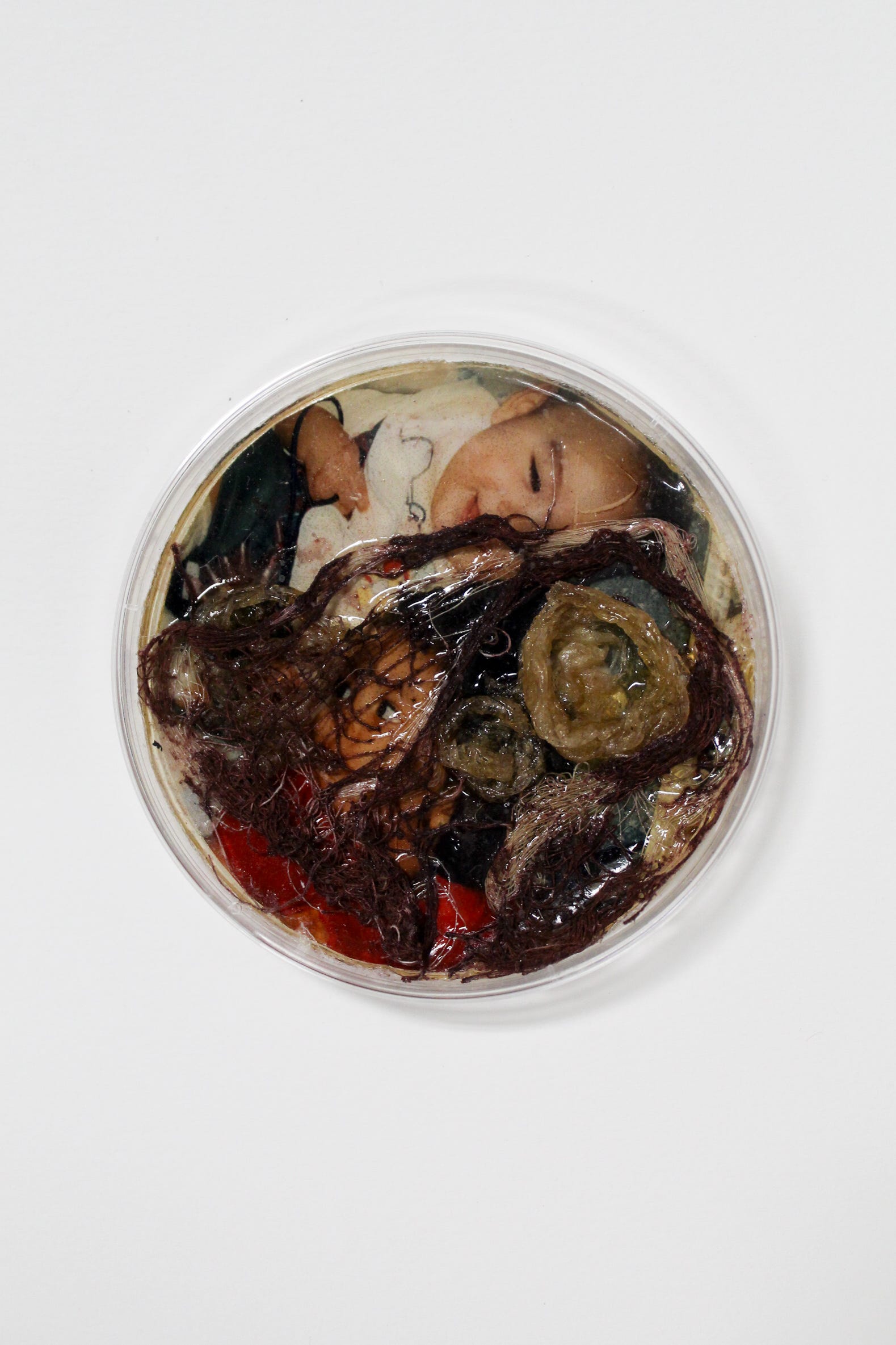
My inspiration draws a lot from my memories and myself digging into what it is what causes them to be at the forefront of my mind. I’m really into psychoanalysis, specifically feminist-based psychoanalysis. I enjoy reading the work of writers such as Julia Kristeva, Siri Husvet and Sara Ahmed. They help me to really understand how it is that I work, and it has been interesting to see how fields like this have been bastardized by its history. After seeing how other people have used psychoanalysis as a framework for feminist discourse, and how they used in poetry and prose, it excited me to see those worlds melding together in art.
My professor brought this subject up in a class, so I looked it up and it became this whole rabbit hole. I have been in the mental health system for a lot of my childhood, so I never really understood why I was doing certain things or how were they working. Psychoanalysis became a good way to start excavating wounds and trauma and look for answers.
“After seeing how other people have used psychoanalysis as a framework for feminist discourse, and how they used in poetry and prose, it excited me to see those worlds melding together in art”
Q: How do you approach creating an artwork?
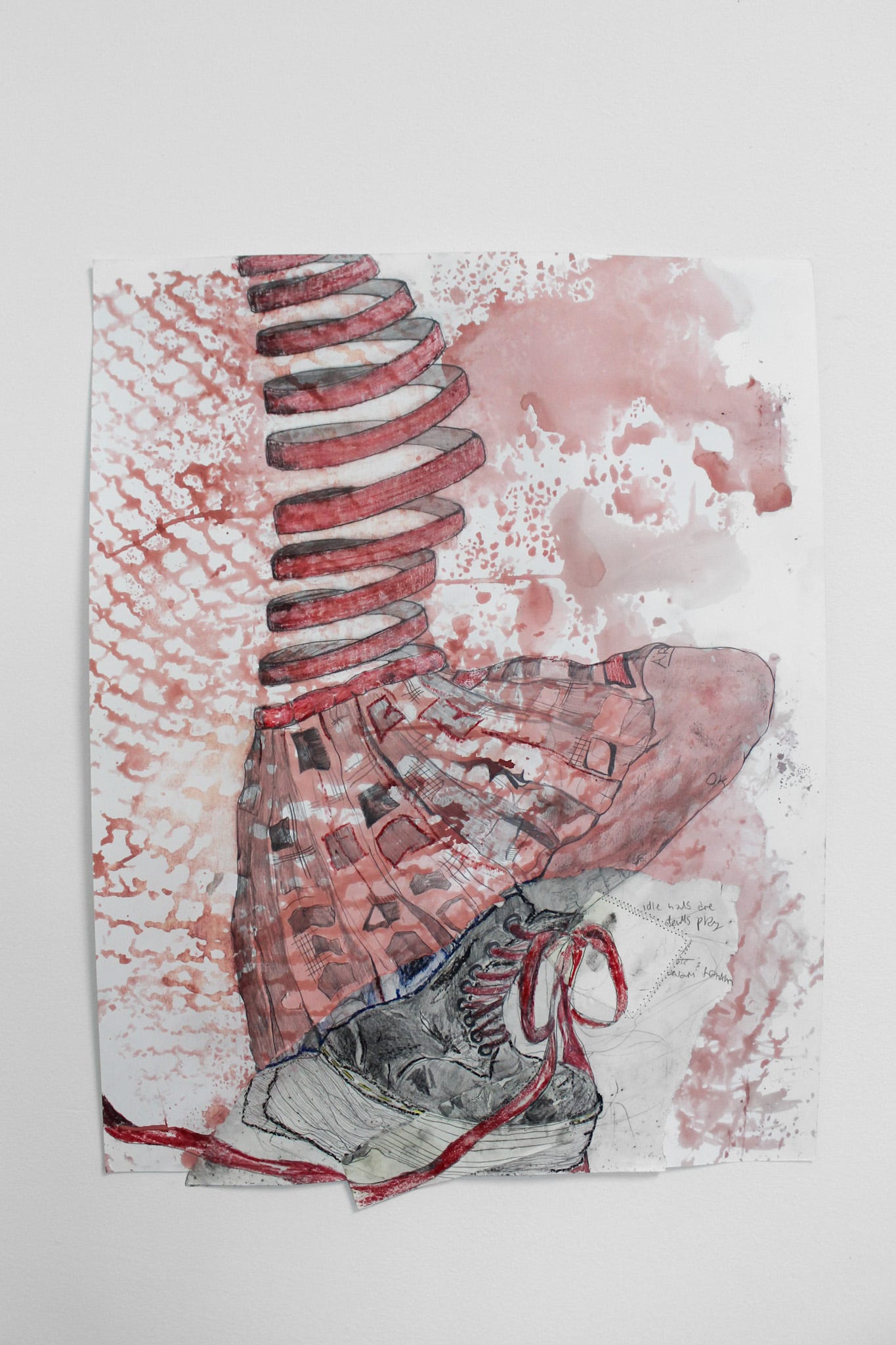
Ophelia Arc: I have this kind of process now where I'll first do the research that inspires the sketch, and from then I decide what medium or mode of execution will best serve the idea I have. Sometimes it can be a drawing, sometimes it can be a sculpture. Sometimes, it can be a drawing of a sculpture, or a sculpture of a drawing.
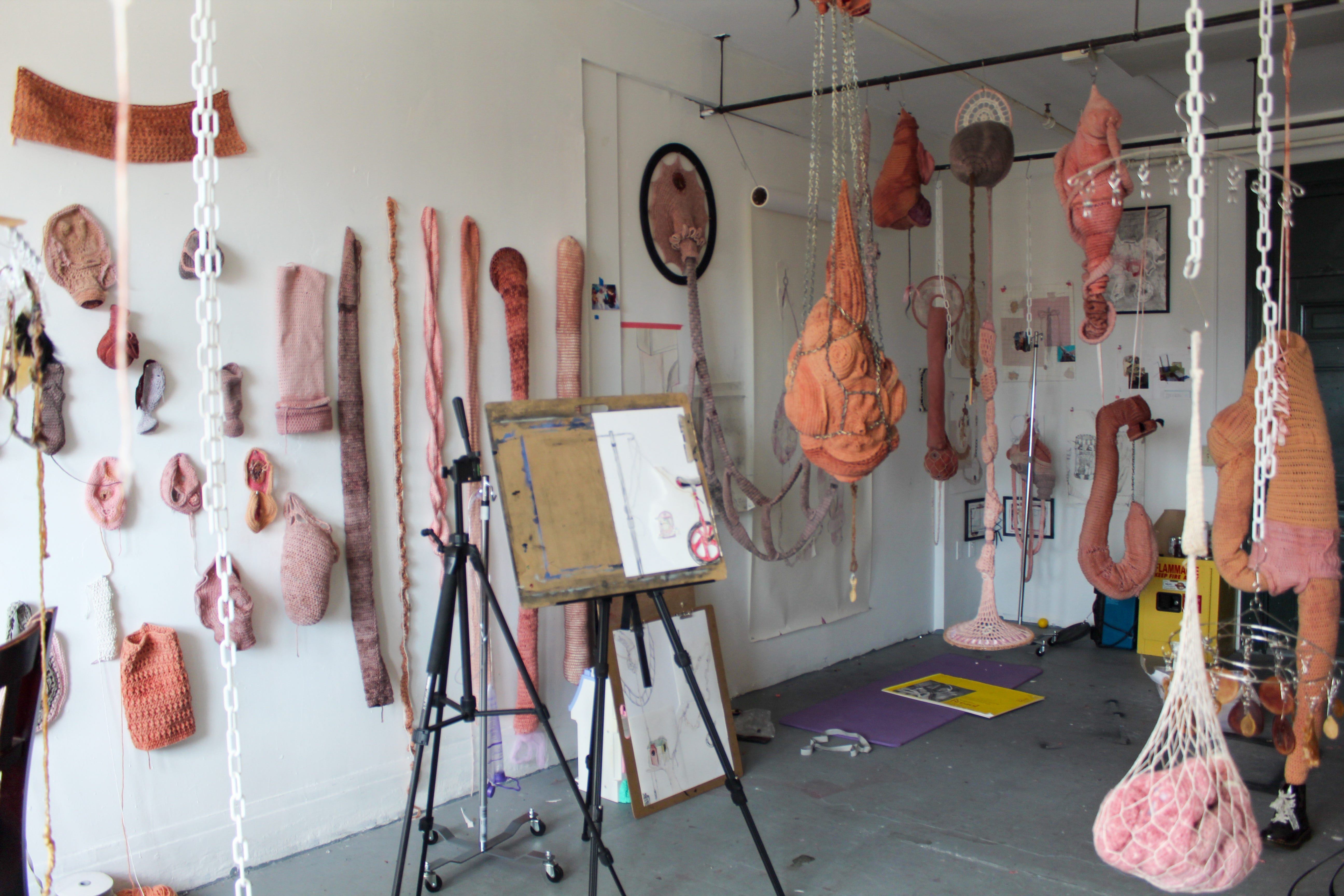
Q: Your work involves a lot of crochet. What did you find in crochet that you didn't find in other mediums? How did you start using it?
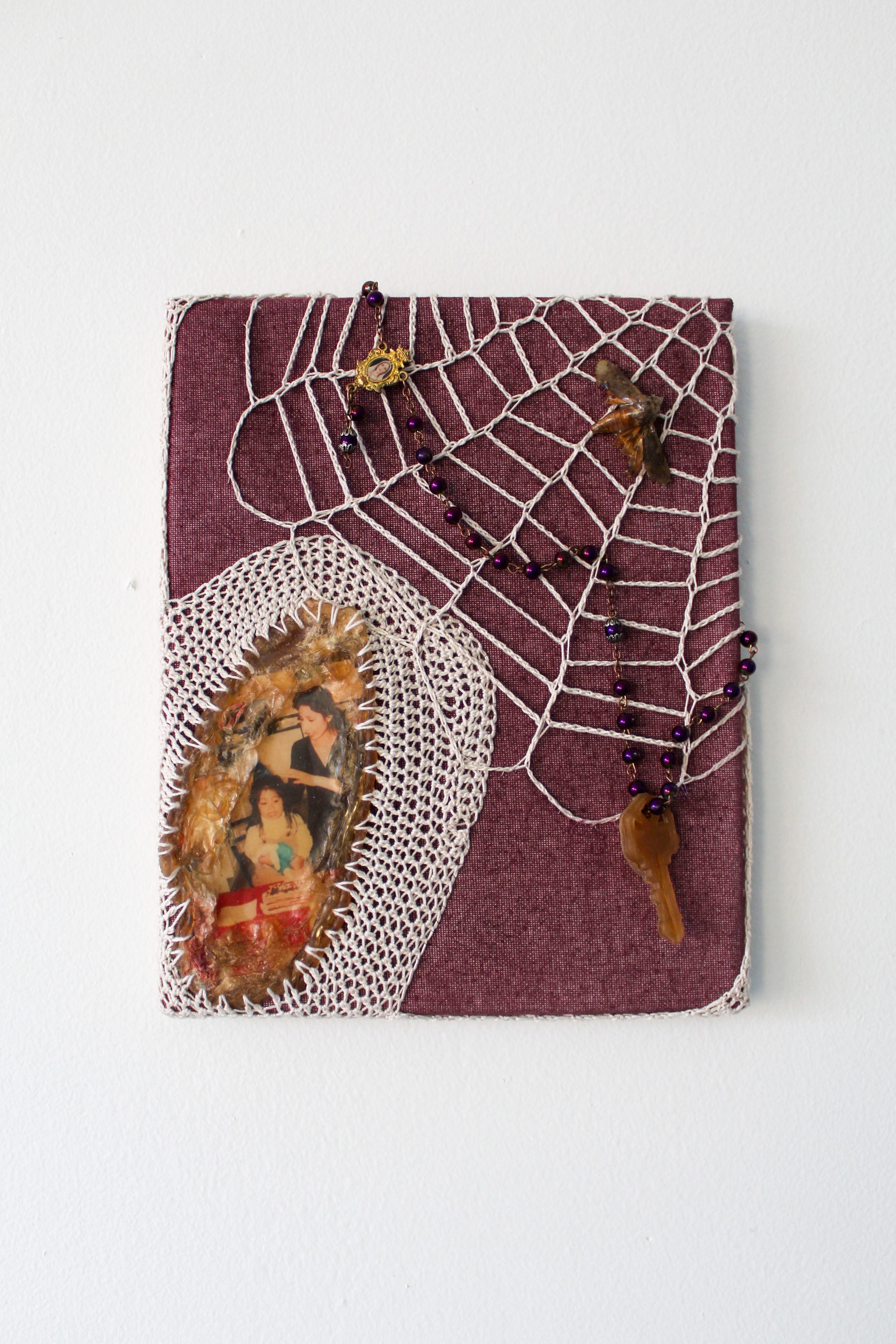
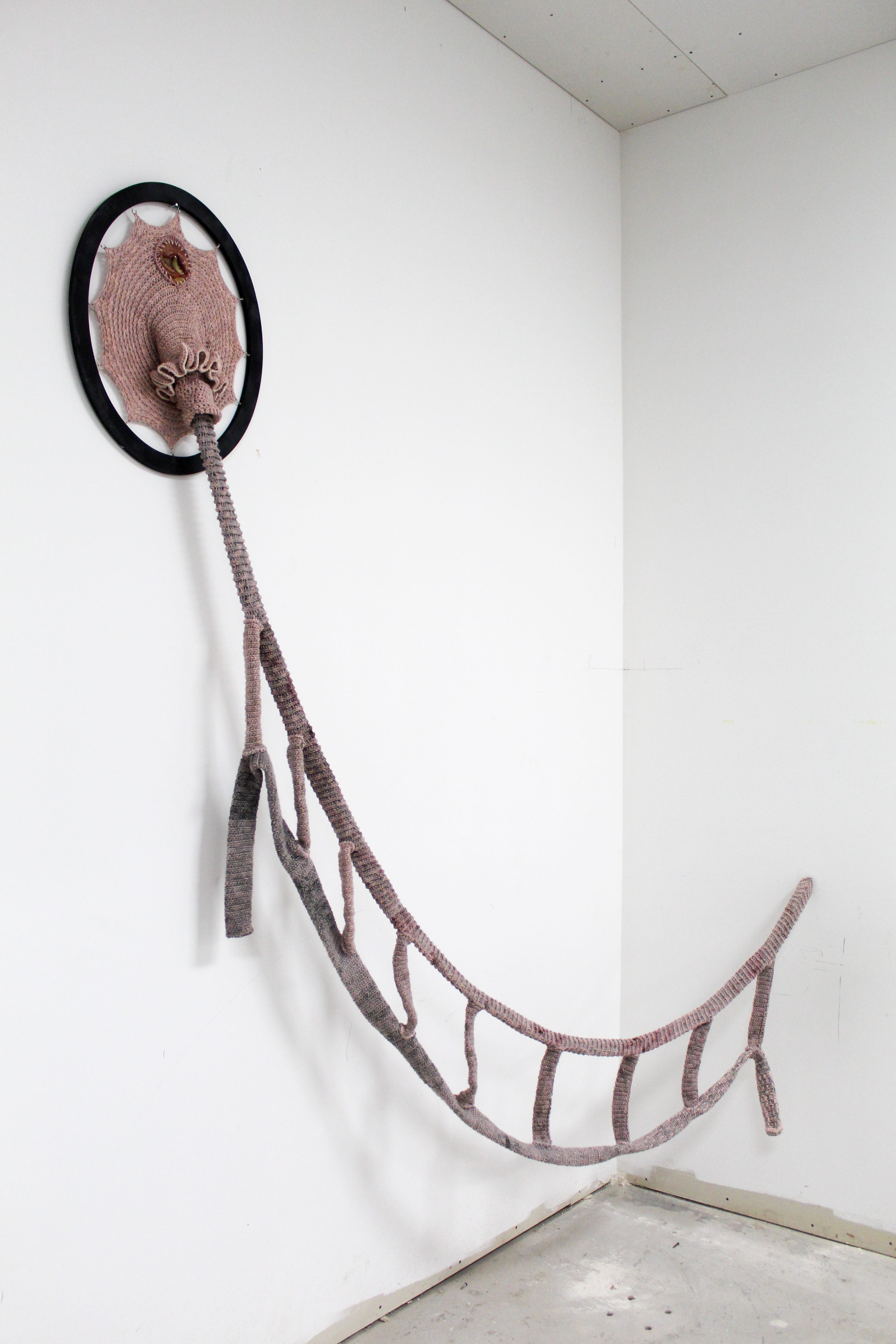
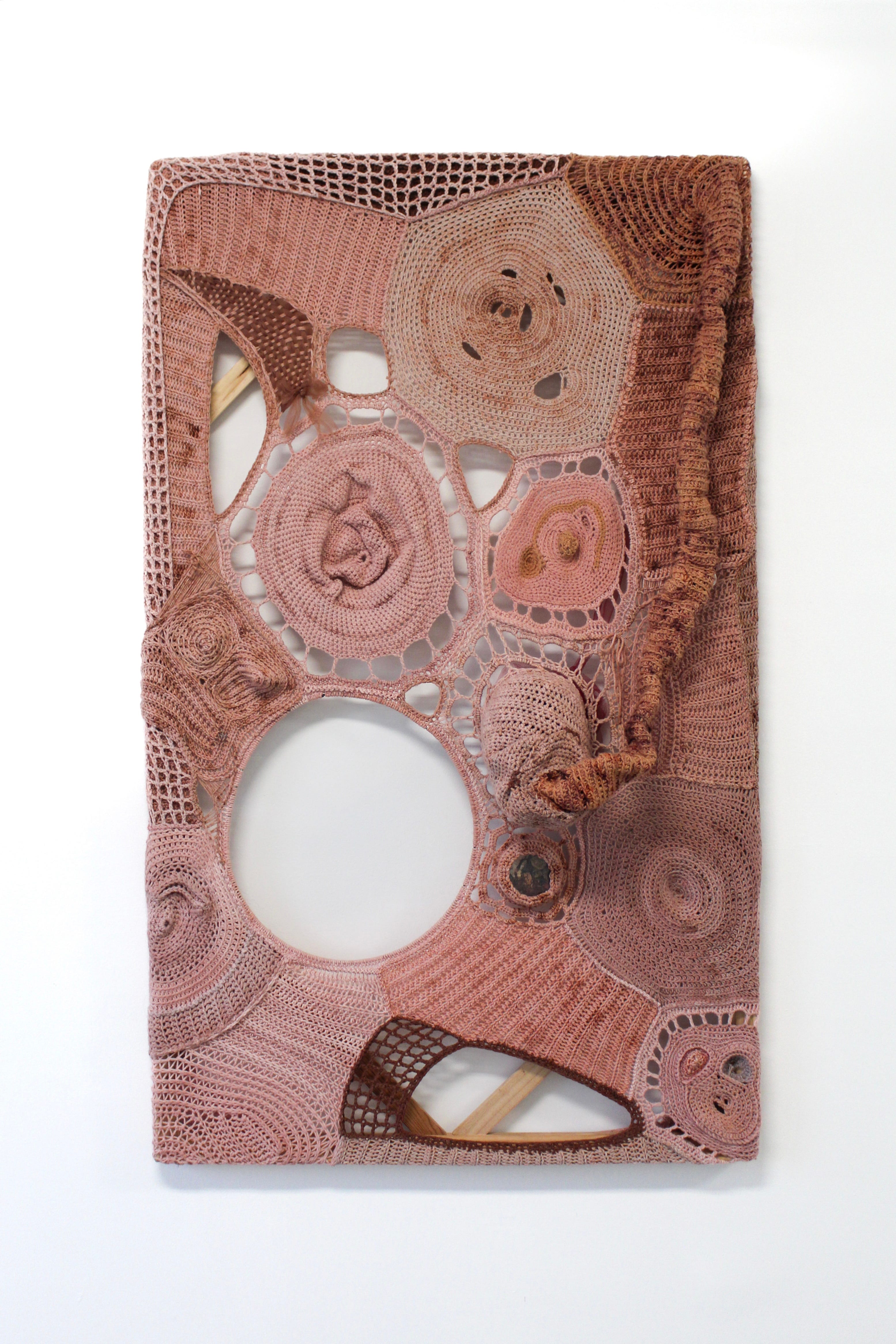
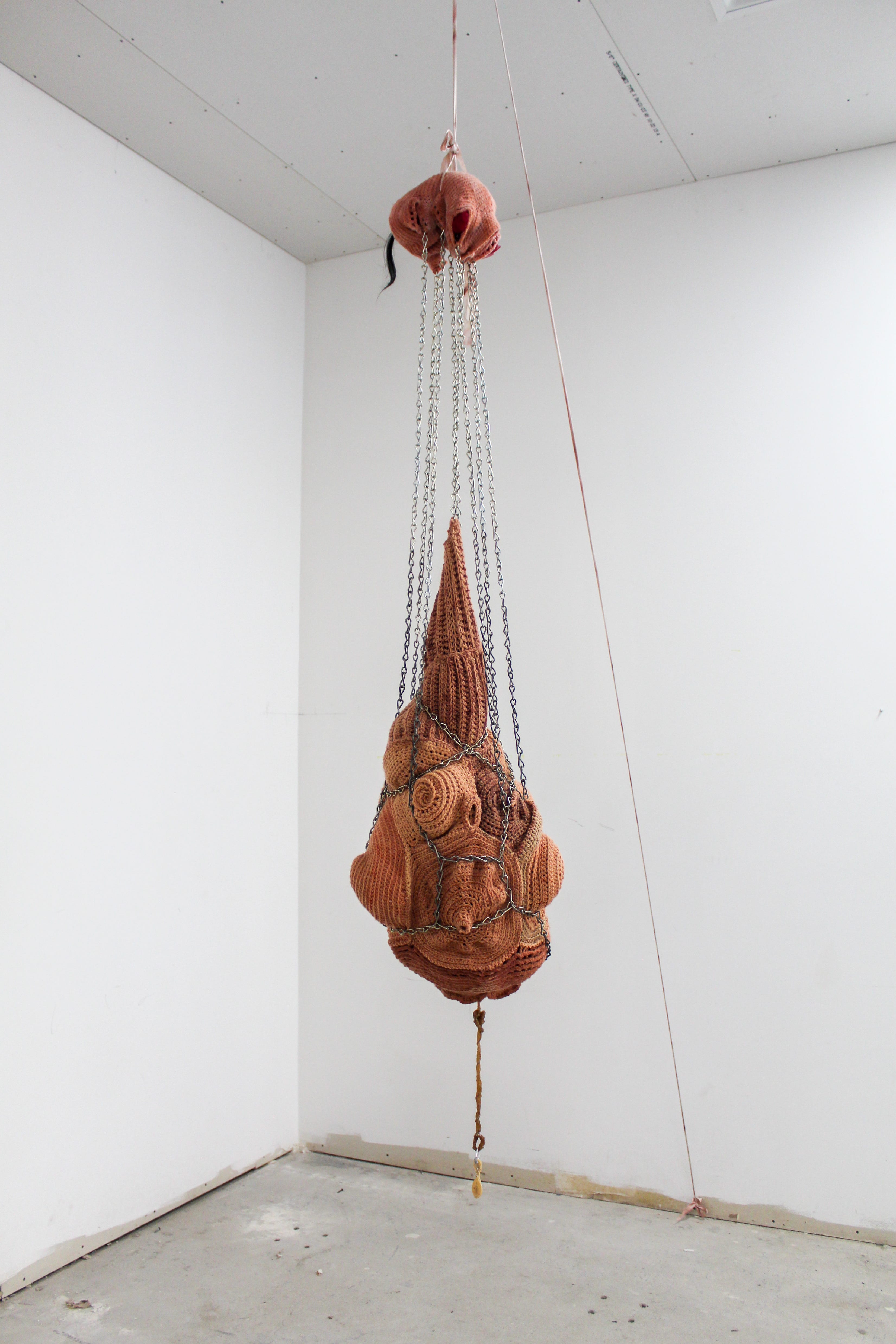
Ophelia Arc: I started with crochet super randomly. As a kid, I grew up in a small town, and in between many random stores, there was a yarn shop. One day, I just walked in and thought I wanted to learn something new. So, I bought the cheapest thing, which at the time my reasoning was: “One hook is cheaper than two needles, right?” So, I bought one hook and a ball of yarn, and I taught myself how to crochet. To do so became a place where I could put all this nervous energy I had. I’m usually always doing something with my hands, so it became a tactile memory. As a kid, I had a stuffed animal that I always held, so that touch component that I missed for so long was filled when I touched the yarn. It was this idea of touch and comfort that I liked, which is linked to the “transitional object” theory. The theory talks about how we can have a transitional object as kids that helps us to wane off our mother, giving us this sense of protection and autonomy. Of course, I didn’t know that at the time, I just knew that I liked the way it felt.
Years later, I had a class where I had to make a sculpture. I didn’t want to go into a wood shop because it was a loud and overstimulating place. So, the idea of doing it with crochet occurred to me. My whole work with crochet took off from there.
“As a kid, I had a stuffed animal that I always held, so that touch component that I missed for so long was filled when I touched the yarn”
Q: Could you explain us your approach to the different yarn colors?
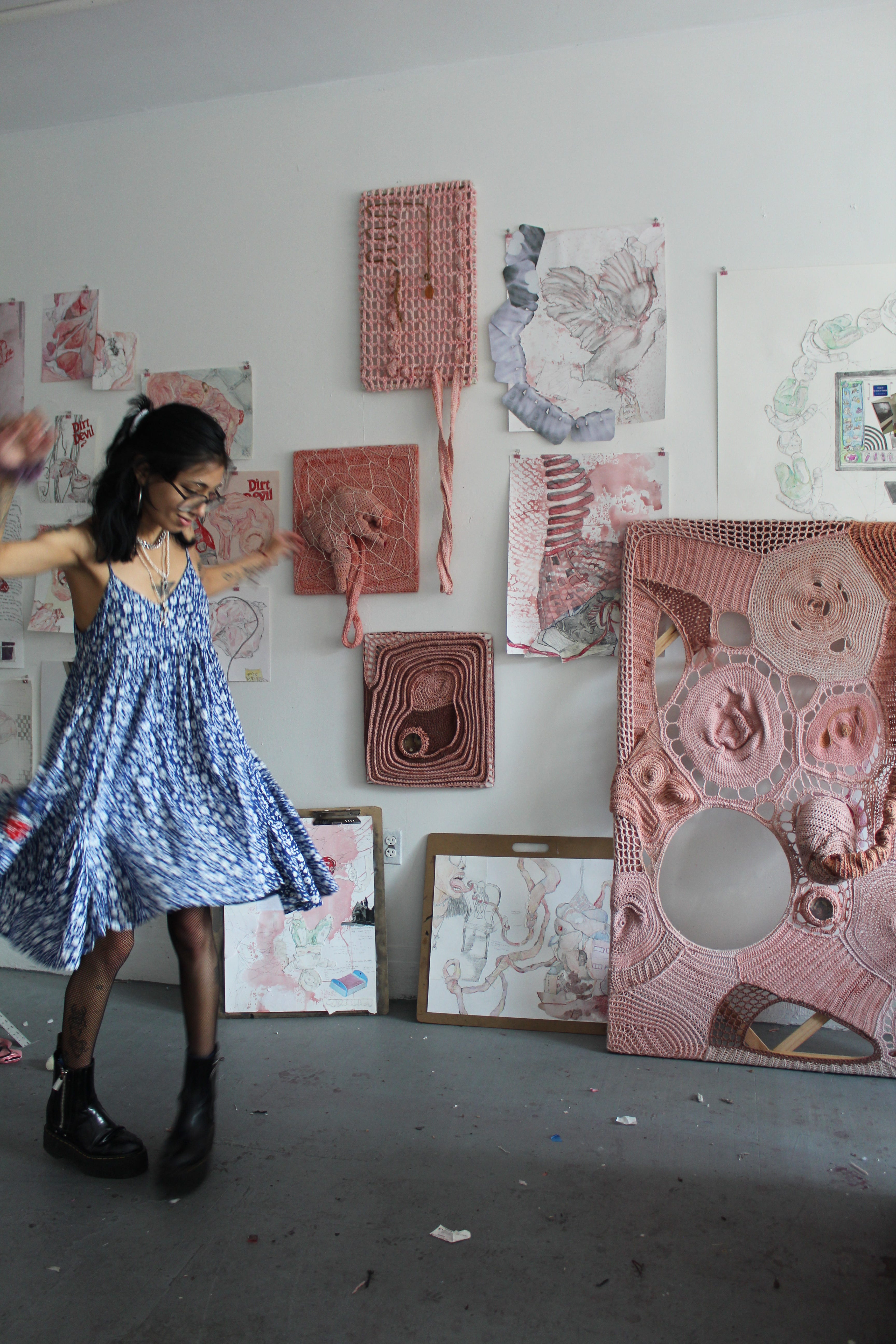
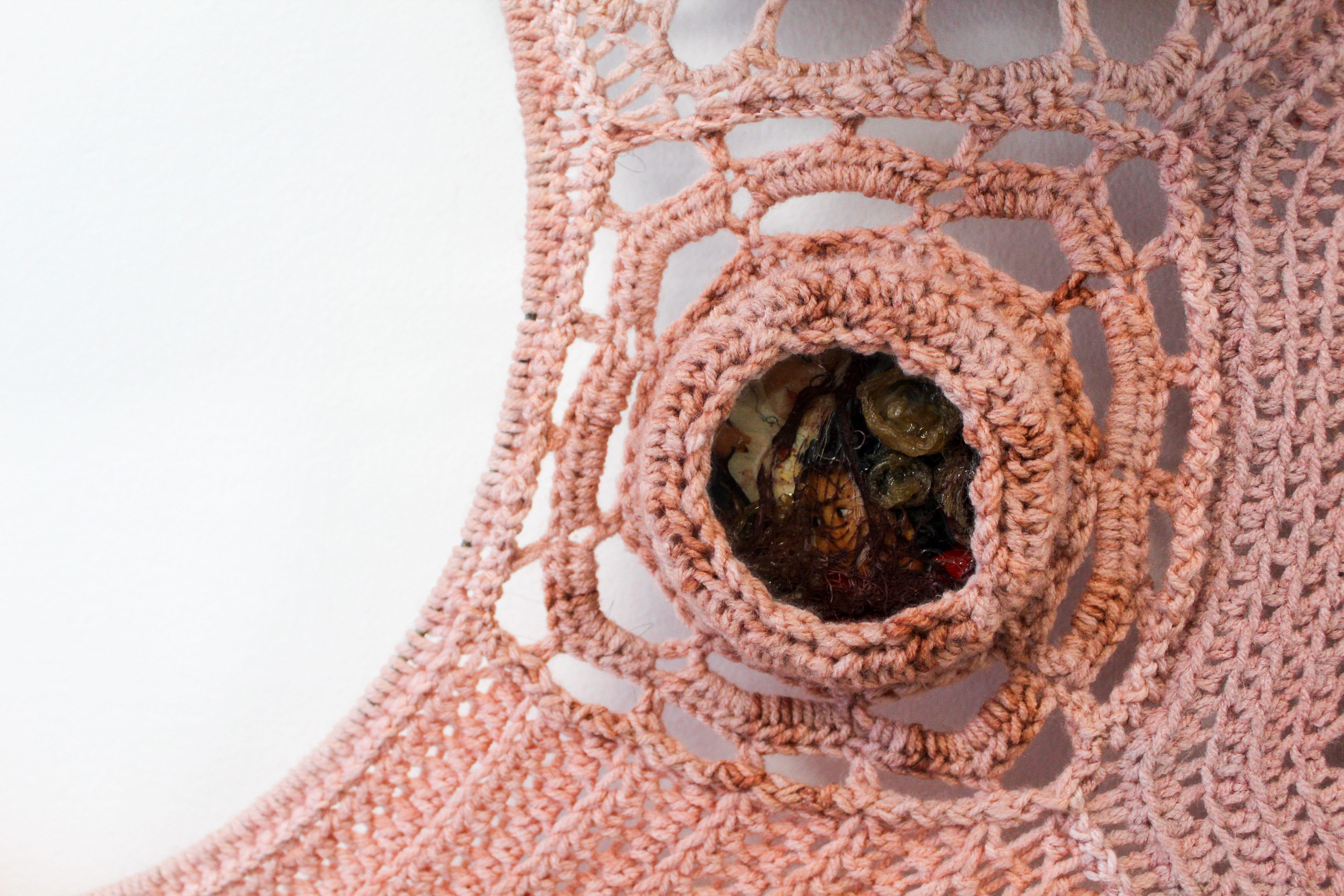
Ophelia Arc: I really love the “push and pull” that kind of happens when you deal with colors like pink. Pink is a very strong color in the sense that it has a lot of connotations and depending on how grotesque I get, I can really push it to a stronger side, or I can push it towards a girly, soft nature.
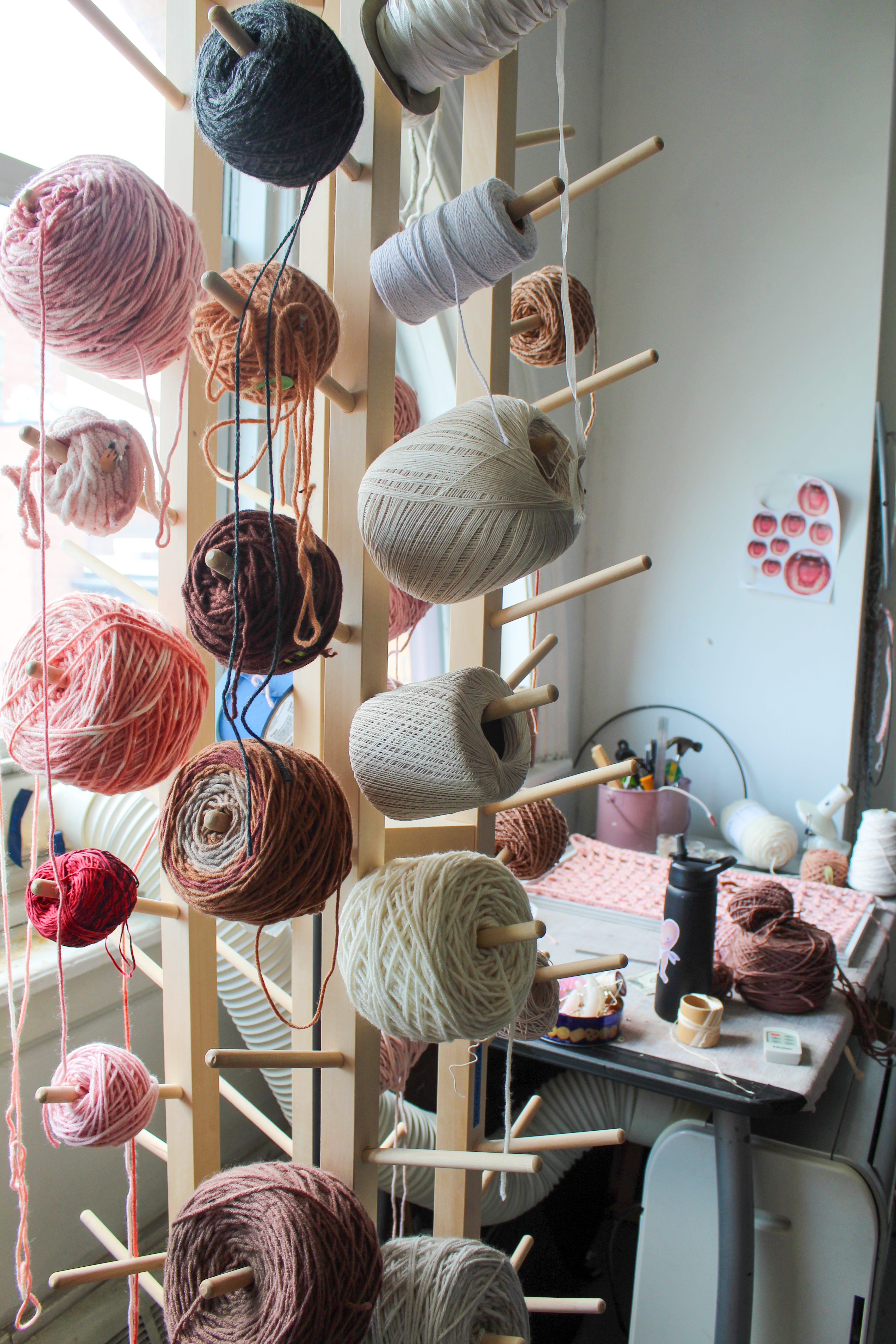
I'm also really interested in the way pigmentation and the skin functions. I used to buy my yarn pre-dyed but then, I started noticing the yellow hues in the skin or blue veins that kind of pop, so now I dye the yarn myself to have more control over the color. It is a lengthy process: Every two months, I make three dye buckets. I start the process in the morning, I put the yarn in at night, I take out the yarn and I string it out to dry. Then, I wash it in the next morning, let it dry while the other yarns are sitting in the bath, and finally spin it out and then switch out. I have all the colors in a rack, so I can kind of see my inventory. I like to do it in bulks, so this takes a good two weeks to get different shades and colors.
Q: Do you think your cultural identity plays a role in your work?
Ophelia Arc: It is interesting to talk about this because, until a few years ago, I had no idea of the rich cultural history that there is behind textiles within countries like Peru and Chile. So, when I found out, I went like: “Oh my God, how did I get here?”
As someone who is estranged from their family, my use of medium opened a thought process for me. I didn't know for a while how my Latin American origins played in my art, until I realized that they are inherently present everywhere. Clearly, textiles, the use of the yarns and crochet, remind us of a lot of the Latin American heritage in a way.
“I didn't know for a while how my Latin American origins played in my art, until I realized that they are inherently present everywhere”
Q: What would you like the viewers to feel or think when they see your work?
Ophelia Arc: I think I'm making my work for a very specific group of people. If you are part of that group, you know the feeling I’m evoking.
People who have experienced the same things I have can recognize objects like the feeding tube in my work. I always like to leave these sorts of small easter eggs in my pieces, whether it's the tip of a hospital bracelet or the edge of an Ensure bottle. However, I also aim for my pieces to be accessible, allowing those who haven't had similar experiences to project their own lives onto the artwork. It can be as simple as someone liking the way I use yarn.
Long term, my goal is to have a practice that exists outside of a typical art space. I’d love to do commissions for psychiatric institutions and having my pieces to give a feeling of safety, and function as transitional objects for people as they go back into society.
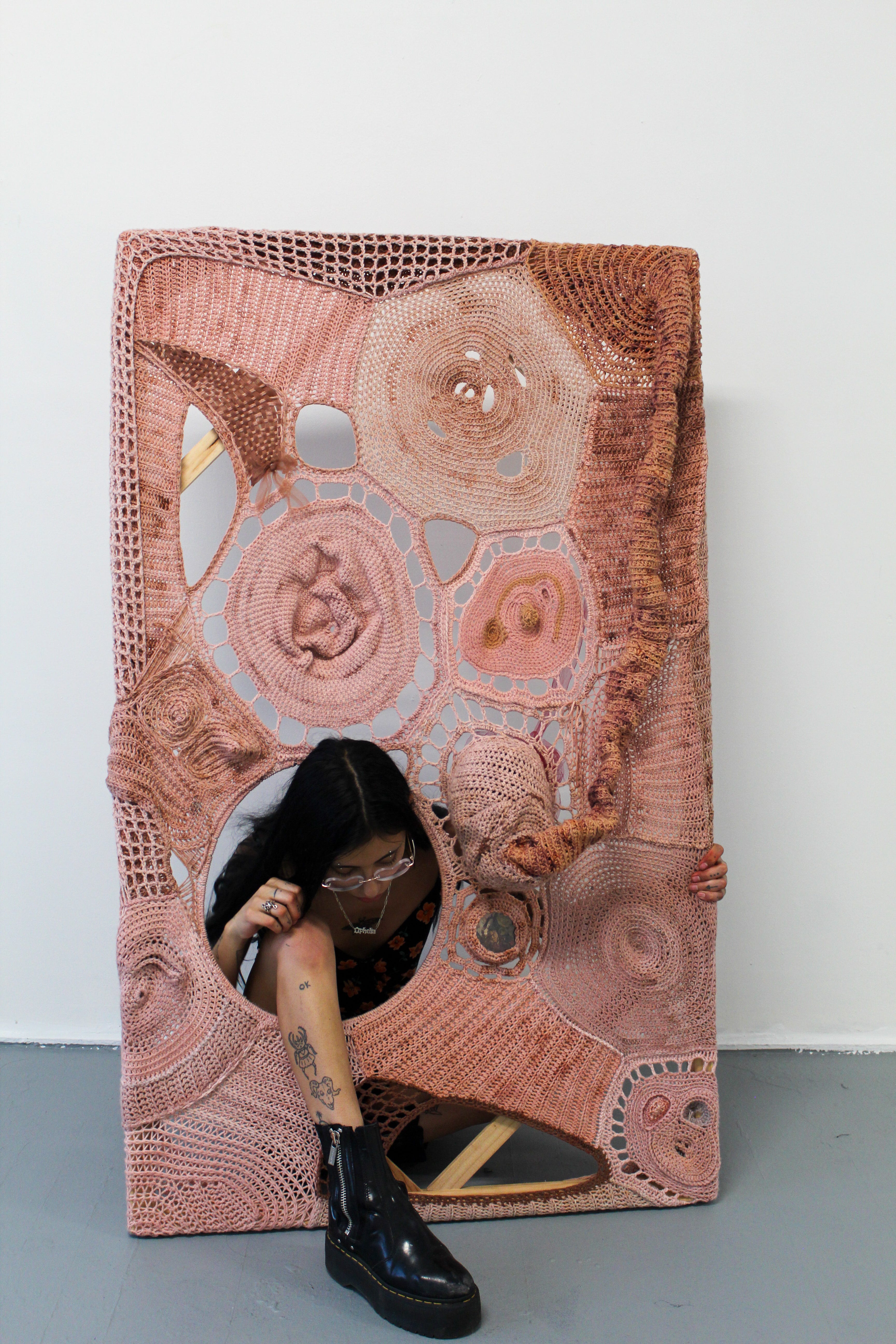
Q: You had your first solo exhibition “we’re just so glad you’re home” this year. How was this experience and what have you learnt from it?
Ophelia Arc: Up to this year, I had never really shown my work in a big platform, so it was very scary. Having a show in Tribeca, Art News covering it, and having all these images circulating was crazy. I don't think any artist makes a piece thinking no one is going to see it, but when it happens, it feels like you are flaying your body out there. Still, it was such an incredible experience. I had the opportunity to work with Nakai Falcón, the curator of the show, who was genuinely invested in learning about my work and me as an artist and a person experiencing the world and projecting it outwards. I left like he really saw me.
To exhibit my work has made me feel like I’m not just screaming out to the void, but there are people in vicinity now. What I love most about my art is that those who don’t care about me or my work won't bother to notice the easter eggs I leave behind. Of course, that is totally fine because those aren't the people that I want to be familiar with my whole history. So, I feel there is this kind of barrier that protects me: Although I am showing a lot of myself, I’m also not showing myself at all to some. It has definitely been comforting to know that I can operate in these different modes for different people.
“To exhibit my work has made me feel like I’m not just screaming out to the void, but there are people in vicinity now”
Q: We heard you have an upcoming gallery solo show in 2025. What can you tell us about it?
Ophelia Arc: I’m fortunate to be working with Lyles & King for my solo show in 2025. The gallery is incredibly supportive of their artists, and they truly trust my creative vision, which is rare these days. I’ve shown that I can produce a lot of work, and I have many ideas. My goal is to create as much as I feel inspired to. I never want to be in a position where I’m forced to make work that doesn’t feel authentic, because my art is deeply tied to who I am.
“My goal is to create as much as I feel inspired to. I never want to be in a position where I’m forced to make work that doesn’t feel authentic, because my art is deeply tied to who I am”
Q: In the age of Instagram, how do you view the role of social media in your artistic practice? What benefits and challenges have you encountered by sharing your work online?
Ophelia Arc: It is really crazy how much artists almost need Instagram nowadays; it feels like everyone expects you to have an account. But for me, as someone who loves to look at archives, I realized that stories, posts or screenshots can help me build my own online archive.
My archive will not be etched in stone but will be on Instagram. I see this platform as a form of documentation: I post a lot of my work’s process in my stories, and it's partially because people seem to enjoy it. I also like having these timestamps, so I can come back to them from time to time or someone who is really interested in my work can also do so.
However, a big challenge is the social pressure that comes with this. When I first started drawing, I posted one piece that got very little engagement and, I internally interpreted that as a sign that I wasn’t good at it. Eventually, I understood that Instagram was used to me posting these really big sculptures, so it was just an issue with the algorithm. Of course, I considered about deleting the post for many days but ultimately decided to keep it because it was all just in my head, you know?
Q: Do you think that sharing your process online has changed the way that viewers perceive your work compared to other traditional settings, like galleries?
Ophelia Arc: It is interesting because I also post on TikTok sometimes. TikTok shows your content to people that don't follow you, so my favorite thing about it is the comment section. When you are at a gallery and someone sees your work, it is unlikely that they will tell you they hate it. But, on TikTok, I’ve been told things like: “Ew, this makes me so uncomfortable.” And I’m like, oh, thank you.
I sometimes go on TikTok live and just crochet to show my work. It is a nice way to connect with people and answer to their questions live. At RISD, everyone knows about art and platforms like TikTok allow me to talk to people that aren’t very familiar with it but that are interested in knowing more about it. It feels like taking down this invisible barrier that sometimes galleries or museums build.
Instagram works almost the same way. People can reach out to me at any time, so it becomes a way of continuing conversations outside of the typical gallery spaces. When I first started posting, I had around 500 followers. No one knew what I was doing, they were like: “Why is she crocheting at 2 am?” But I just kept doing it because I liked saving the videos, and since I didn’t have space on my phone, I saved everything on Instagram. To be active on social media gave my work the chance to be seen by so many people.
“To be active on social media gave my work the chance to be seen by so many people”
Q: Do you have any artists that you constantly find yourself going back to their work or that you admire?
Ophelia Arc: Definitely. Louise Bourgeois is a classic. I’m also really into Mandy El-Sayegh, I discovered her work at a Lehman Maupin show a few years ago and it changed my life. There are also two artists: Mercedes Llanos and Ana Villagomez, whose thesis I saw at Hunter as an undergrad.
To learn more about Ophelia Arc, visit:
https://www.ceaseandperish.com/

Ophelia Arc es una artista multidisciplinaria basada en la investigación con raíces chilenas y peruanas, actualmente residiendo en Providence, EE.UU. Mientras completa su último año de estudios, ya está causando un impacto significativo en la escena artística, habiendo realizado su primera exhibición individual en una galería de arte en Nueva York el año pasado.
Acompáñanos a conocer la obra de Ophelia, las inspiraciones que hay detrás de sus creaciones y su opinión acerca del impacto de las redes sociales en los artistas de hoy en día.
Q: ¿Podrías presentarte y describir la inspiración que hay detrás de tu trabajo?
Ophelia Arc: Soy Ophelia y vivo en Providence, Estados Unidos. Estoy cursando el último año de mi MFA en escultura en la Rhode Island School of Design (RISD). Mi ciudad de origen es Nueva York, adonde pienso volver cuando acabe el programa.
Me inspiro mucho en mis recuerdos y en mí misma indagando en las causas que los mantienen en mi mente. Me gusta mucho el psicoanálisis, en concreto el psicoanálisis feminista. Me gusta leer la obra de escritoras como Julia Kristeva, Siri Husvet y Sara Ahmed. Me ayudan a entender realmente cómo es que trabajo, y ha sido interesante ver cómo campos como éste han sido bastardizados por su historia. Después de ver cómo otras personas han utilizado el psicoanálisis como marco para el discurso feminista, y cómo lo utilizaban en poesía y prosa, me emocionó ver cómo esos mundos se podían entrelazar en el arte.
Mi profesor sacó el tema en una clase, así que lo investigué y se convirtió en todo un espiral. Pasé gran parte de mi infancia en el sistema de salud mental, así que nunca entendí por qué hacía ciertas cosas o cómo funcionaban. El psicoanálisis se convirtió en una buena forma de empezar a desenterrar heridas y traumas y buscar respuestas.
“Después de ver cómo otras personas han utilizado el psicoanálisis como marco para el discurso feminista, y cómo lo utilizaban en poesía y prosa, me emocionó ver cómo esos mundos se podían entrelazar en el arte”
Q: ¿Cómo abordas la creación de una obra de arte?
Ophelia Arc: En la actualidad, sigo un proceso en el que primero investigo lo que inspira el boceto y luego decido qué medio o modo de ejecución será mejor para la idea que tengo. A veces puede ser un dibujo, a veces una escultura. A veces puede ser el dibujo de una escultura o la escultura de un dibujo.
Q: En tu trabajo utilizas mucho el crochet. ¿Qué has encontrado en el crochet que no hayas encontrado en otros medios? ¿Cómo empezaste a utilizarlo?
Ophelia Arc: Empecé con el crochet de forma muy accidental. De niña, crecí en una pequeña ciudad y, en medio de muchas tiendas al azar, había una tienda de hilos. Un día entré y pensé que quería aprender algo nuevo. Así que compré lo más barato, que en aquel momento mi razonamiento era: "Un ganchillo es más barato que dos agujas, ¿no?". Así que compré un ganchillo y un ovillo de hilo, y me enseñé a mi misma a tejer crochet. Hacerlo se convirtió en un lugar donde podía poner toda esa energía nerviosa que tenía. Por lo general, siempre estoy haciendo algo con las manos, así que se convirtió en un recuerdo táctil. De niña, siempre tenía un peluche en la mano, así que ese componente táctil que eché de menos durante tanto tiempo se llenaba cuando tocaba el hilo. Me gustaba esta idea del tacto y la comodidad, que está relacionada con la “teoría del objeto transicional". Esta teoría habla de cómo de niños podemos tener un objeto transicional que nos ayude a desprendernos de nuestra mamá, dándonos esa sensación de protección y autonomía. Por supuesto, yo no lo sabía en ese momento, sólo sabía que me gustaba la sensación que me producía.
Años más tarde, tuve una clase en la que tenía que hacer una escultura. No quería ir a un taller de madera porque era un sitio ruidoso y sobre estimulante. Así que se me ocurrió la idea de hacerlo a crochet. A partir de ahí empezó todo mi trabajo con el crochet.
“De niña, siempre tenía un peluche en la mano, así que ese componente táctil que eché de menos durante tanto tiempo se llenaba cuando tocaba el hilo”
Q: ¿Podrías explicarnos tu enfoque de los distintos colores de hilo?
Ophelia Arc: Me encanta el «tira y afloja» que se produce cuando trabajas con colores como el rosado. El rosado es un color muy fuerte en el sentido de que tiene muchas connotaciones y, dependiendo de lo grotesca que me ponga, puedo empujarlo hacia un lado más fuerte, o puedo empujarlo hacia una naturaleza femenina y suave.
También me interesa mucho el funcionamiento de la pigmentación y la piel. Antes compraba los hilos ya teñidos, pero entonces empecé a fijarme en los tonos amarillos de la piel o en las venas azules que saltan a la vista, así que ahora tiño los hilos yo misma para tener más control sobre el color. Es un proceso largo: Cada dos meses hago tres cubos de tinte. Empiezo el proceso por la mañana, meto el hilo por la noche, lo saco y lo cuelgo para que se seque. La mañana siguiente lo lavo y lo dejo secar mientras los otros hilos están en la bañera y, por último, lo enrosco y lo cambio. Tengo todos los colores en un estante, así puedo ver mi inventario. Me gusta hacerlo a montones, así que tardo unas dos semanas en conseguir diferentes tonos y colores.
Q: ¿Crees que tu identidad cultural desempeña un papel en tu trabajo?
Ophelia Arc: Es interesante hablar de esto porque, hasta hace unos años, no tenía ni idea de la riqueza de la historia cultural que hay detrás de los textiles en países como Perú y Chile. Así que, cuando lo descubrí, pensé: "Dios mío, ¿cómo he llegado hasta aquí?".
Como una persona distanciada de su familia, el uso de este medio me abrió un proceso de reflexión. Durante una época no sabía cómo influían mis raíces latinoamericanas en mi trabajo, hasta que me di cuenta de que están inherentemente presentes en todas partes. Está claro que los tejidos, el uso del hilo y el crochet, recuerdan mucho en cierto modo a la herencia latinoamericana.
“Durante una época no sabía cómo influían mis raíces latinoamericanas en mi trabajo, hasta que me di cuenta de que están inherentemente presentes en todas partes”
Q: ¿Qué te gustaría que sintieran o pensaran los espectadores al ver tu obra?
Ophelia Arc: Creo que hago mi trabajo para un grupo muy específico de personas. Si tú formas parte de ese grupo, conoces el sentimiento que evoco.
Las personas que han experimentado lo mismo que yo pueden reconocer en mi obra objetos como la sonda de alimentación. Siempre me gusta dejar este tipo de pequeños "huevos de pascua” en mis piezas, ya sea la punta de un brazalete de hospital o el borde de una botella de Ensure. Sin embargo, también pretendo que mis obras sean accesibles, que permitan a quienes no han tenido experiencias similares proyectar sus propias vidas en ellas. Puede ser algo tan sencillo como que a alguien le guste la forma en que utilizo el hilo.
A largo plazo, mi objetivo es tener una práctica que exista fuera de un espacio artístico típico. Me encantaría hacer encargos para instituciones psiquiátricas y que mis obras dieran una sensación de seguridad y funcionaran como objetos de transición para las personas que se reincorporan a la sociedad.
Q: Este año has montado tu primera exhibición individual, "We're so glad you're home". ¿Cómo fue esta experiencia y qué has aprendido de ella?
Ophelia Arc: Hasta este año, nunca había expuesto en una gran plataforma, así que me daba mucho miedo. Hacer una muestra en Tribeca, que Art News la cubriera y que circularan todas esas imágenes fue una locura. No creo que ningún artista haga una obra pensando que nadie va a verla, pero cuando ocurre, sientes como si estuvieses desnudándote ahí fuera. Aun así, fue una experiencia increíble. Tuve la oportunidad de trabajar con Nakai Falcón, el curador de la exhibición, que estaba realmente interesado en aprender sobre mi trabajo y sobre mí como artista y como persona que experimenta el mundo y lo proyecta hacia afuera. Con él, me sentí realmente vista.
Mostrar mi trabajo me ha hecho sentir que no estoy solamente gritando al vacío, sino que ahora hay gente cerca. Lo que más me gusta de mi arte es que aquellos a los que no les importo ni yo ni mi trabajo no se molestarán en fijarse en los “huevos de pasqua” que dejo. Por supuesto, no pasa nada, porque esas personas no son las que yo quiero que conozcan toda mi historia. Así que siento que existe una especie de barrera que me protege: Aunque estoy mostrando mucho de mí, también estoy ocultándome para algunos. Definitivamente ha sido reconfortante saber que puedo funcionar de estos modos diferentes para personas diferentes.
“Mostrar mi trabajo me ha hecho sentir que no estoy solamente gritando al vacío, sino que ahora hay gente cerca”
Q: Hemos oído que vas a tener otra exhibición individual en una galería en el 2025. ¿Qué puedes contarnos al respecto?
Ophelia Arc: Tengo la suerte de trabajar con Lyles & King para mi próxima exposición individual en el 2025. La galería apoya increíblemente a sus artistas y realmente confía en mi visión creativa, algo poco frecuente hoy en día. He demostrado que puedo producir muchas obras y que tengo muchas ideas. Mi objetivo es crear todo lo que me inspire. Nunca quiero verme obligada a hacer obras que no me parezcan auténticas, porque mi arte está profundamente ligado a lo que soy.
“Mi objetivo es crear todo lo que me inspire. Nunca quiero verme obligada a hacer obras que no me parezcan auténticas, porque mi arte está profundamente ligado a lo que soy”
Q: En la era de Instagram, ¿cómo ves el rol de las redes sociales en tu práctica artística? ¿Qué ventajas y desventajas has encontrado en compartir tu trabajo en Internet?
Ophelia Arc: Es una locura lo mucho que los artistas necesitan Instagram hoy en día; parece que todo el mundo espera que tengas una cuenta. Pero a mí, que me encanta mirar archivos, me di cuenta de que las historias, los posts o las capturas de pantalla pueden ayudarme a construir mi propio archivo online.
Mi archivo no estará grabado en piedra, sino en Instagram. Veo a esta plataforma como una forma de documentación: Publico mucho sobre el proceso de mi trabajo en mis historias, y en parte es porque a la gente parece gustarle. También me gusta tener estas marcas de tiempo, para poder volver a ellas de vez en cuando o para que alguien que esté realmente interesado en mi trabajo también pueda hacerlo.
Sin embargo, un gran reto es la presión social que esto conlleva. Cuando empecé a dibujar, publiqué una obra que tuvo muy poca interacción y, en mi interior, lo interpreté como una señal de que no era buena haciendo eso. Con el tiempo, comprendí que Instagram estaba acostumbrado a que publicara esculturas enormes, así que era un problema del algoritmo. Por supuesto, me planteé borrar la publicación durante muchos días, pero al final decidí mantenerla porque todo estaba en mi cabeza, ¿entiendes?
Q: ¿Crees que compartir tu proceso en Internet ha cambiado la forma en que los espectadores perciben tu trabajo en comparación con otros entornos tradicionales, como las galerías?
Ophelia Arc: Es interesante porque a veces también publico en TikTok. TikTok muestra tu contenido a gente que no te sigue, así que lo que más me gusta es la sección de comentarios. Cuando estás en una galería y alguien ve tu obra, es poco probable que te diga que la odia. Pero, en TikTok, me han dicho cosas como: «Ew, esto me hace sentir tan incómodo.» Y yo pienso, oh, gracias.
A veces entro a TikTok live y solo hago crochet para mostrar mi trabajo. Es una buena manera de conectar con la gente y responder a sus preguntas en tiempo real. En RISD, todo el mundo conoce de arte y plataformas como TikTok me permiten hablar con gente que no está muy familiarizada con el tema pero que está interesada en saber más sobre él. Es como romper esa barrera invisible que a veces construyen las galerías o los museos.
Instagram funciona casi de la misma manera. La gente puede ponerse en contacto conmigo en cualquier momento, así que se convierte en una forma de continuar las conversaciones fuera de los espacios típicos de las galerías. Cuando empecé a publicar, tenía unos 500 seguidores. Nadie sabía lo que estaba haciendo: «¿Por qué teje a crochet a las 2 de la mañana?». Pero seguí haciéndolo porque me gustaba guardar los vídeos y, como no tenía espacio en el teléfono, lo guardaba todo en Instagram. Ser activa en las redes sociales dio a mi trabajo la oportunidad de ser visto por mucha gente.
“Ser activa en las redes sociales dio a mi trabajo la oportunidad de ser visto por mucha gente”
Q: ¿Hay algún artista al que recurras constantemente o que admires?
Ophelia Arc: Por supuesto. Louise Bourgeois es un clásico. También me gusta mucho Mandy El-Sayegh, descubrí su obra en una exhibición de Lehman Maupin hace unos años y me cambió la vida. También hay dos artistas: Mercedes Llanos y Ana Villagomez, cuya tesis vi en Hunter cuando era estudiante.
Para saber más sobre Ophelia Arc, visita: