


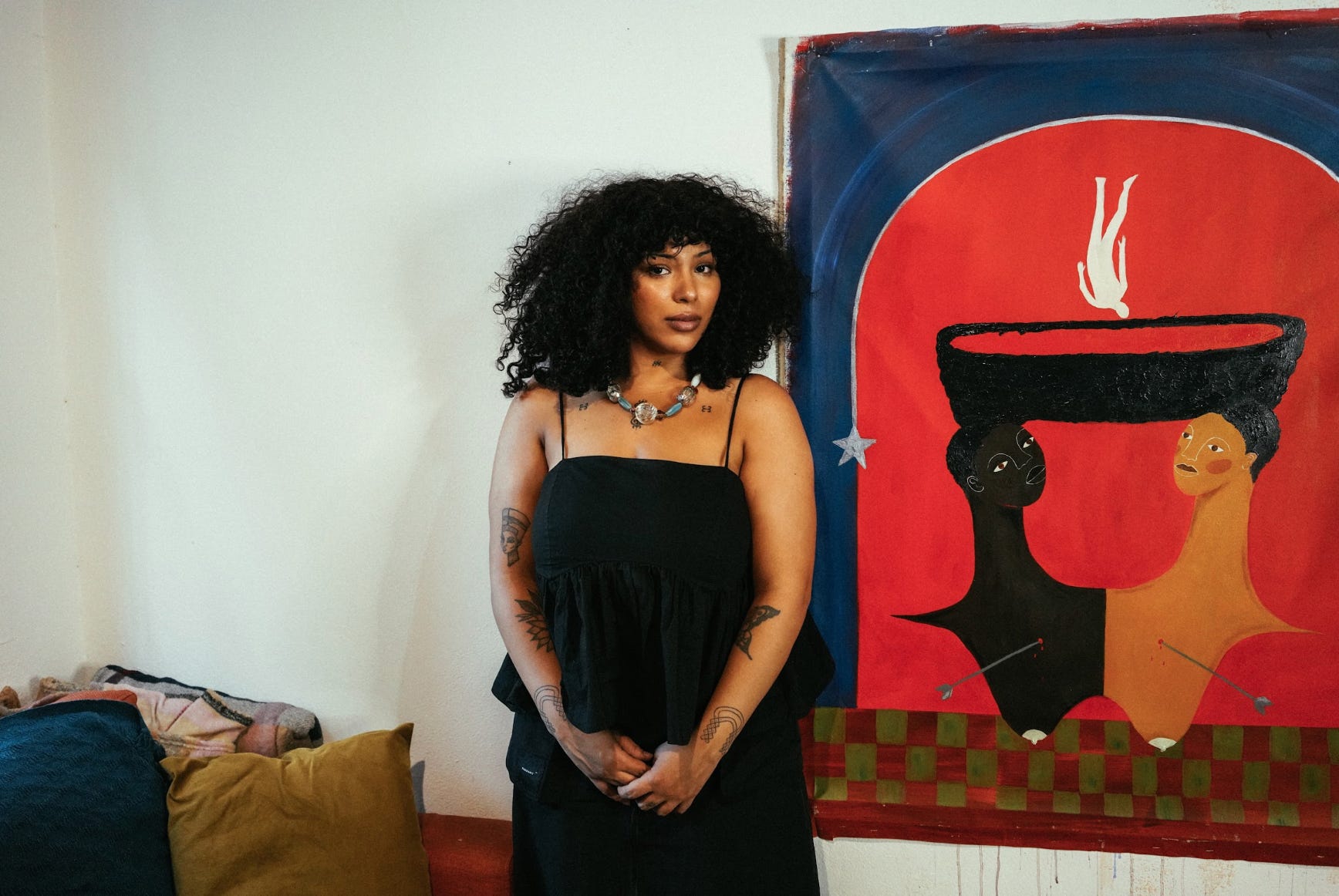
Larissa de Souza is a Brazilian artist whose practice brings together painting, assemblage, memory, and spirituality. Drawing from family histories and her experience as an Afro-Brazilian woman, she explores the relationship between the intimate and the collective through tactile, materially rich compositions.
In this conversation with Art in Latin America, de Souza discusses her self-taught path, the role of ancestry and spirituality in her work, her research in Angola, and the new directions shaping her practice.

Join us in London next month! Art in Latin America paid subscribers receive VIP invitations to selected art fairs, including Paraíso. Upgrade your membership here to receive yours.
You’ve described discovering art despite having limited access to it growing up. How did those early encounters shape your path toward painting?
LS: I think art came to me through imagination. Even though my childhood was marked by social issues, I would create a different world through my imagination. As we grow up, we look for other ways to express ourselves and to keep moving through life. Art became a way for me to continue accessing that place that, until then, had remained in my childhood.
In my pre-teen years, I discovered the city’s graffiti and murals while walking around with my mother or grandmother. Street art is very democratic, and it was through it that I realized I wanted to be an artist. I would use any material that could offer me color: nail polish, charcoal, makeup, eyeshadow, and so on. When I painted, I felt as though I were creating a different universe for myself. I would even paint on the walls of my house.
I started working when I was very young to help my family. Between 2016 and 2021, I worked as a salesperson and later as an art assistant at an art supply store in São Paulo. I always say that place was my college. I learned about different materials and techniques, and I met many artists. It was there that I began painting on canvas and experimenting with different techniques.
You are a self-taught artist. What did that process of learning independently look like for you?
LS: I learned from my family how to “make do with what you have,” so being self-taught has always felt natural to me. It meant painting without being afraid of making mistakes, experimenting, and, through that process, understanding what I liked or didn’t like about the result. It was also about learning through practice and knowing where and when to stop.
Do you think not having formal academic training gave you a particular freedom to develop your own methods and visual vocabulary?
LS: I think academic training has its importance, but I believe that if I had had the opportunity to study art before beginning to work as an artist, my visual language would be different.
Much of your work comes from your experience as an Afro-Brazilian woman, but it also seems that painting has become a way of looking back at your family and the histories that shaped you. How has your understanding of your own identity changed through making art?
LS: I learn a lot through painting; it is almost like a form of self-analysis for me. Even though much of my work comes from a subjective place, it is still collective. I see that many women identify with what I express through it.
I am so grateful for what I do. Working with art has taught me to understand the system we live in, and it has helped me break cycles that seemed to have been predetermined for me. Today, I feel more aware and confident that I can go far.
“I learn a lot through painting; it is almost like a form of self-analysis for me. Even though much of my work comes from a subjective place, it is still collective. I see that many women identify with what I express through it.”
Women are at the center of much of your work. Who are these figures, and how do you think about the women you choose to represent?
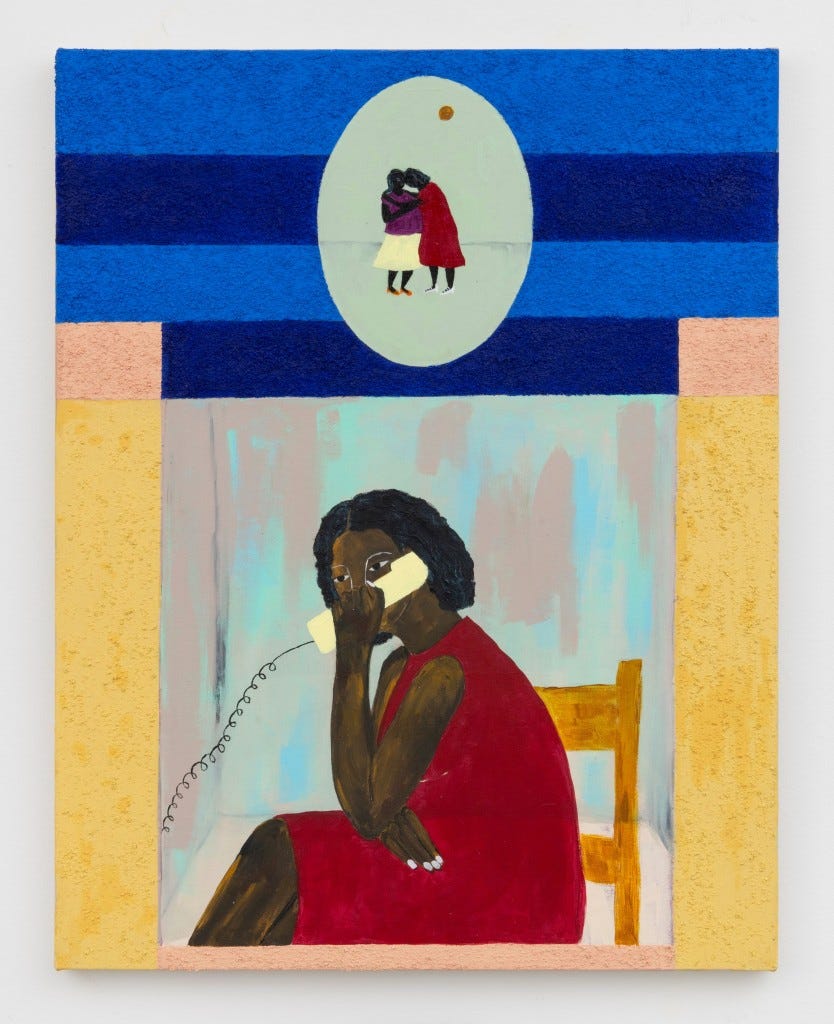
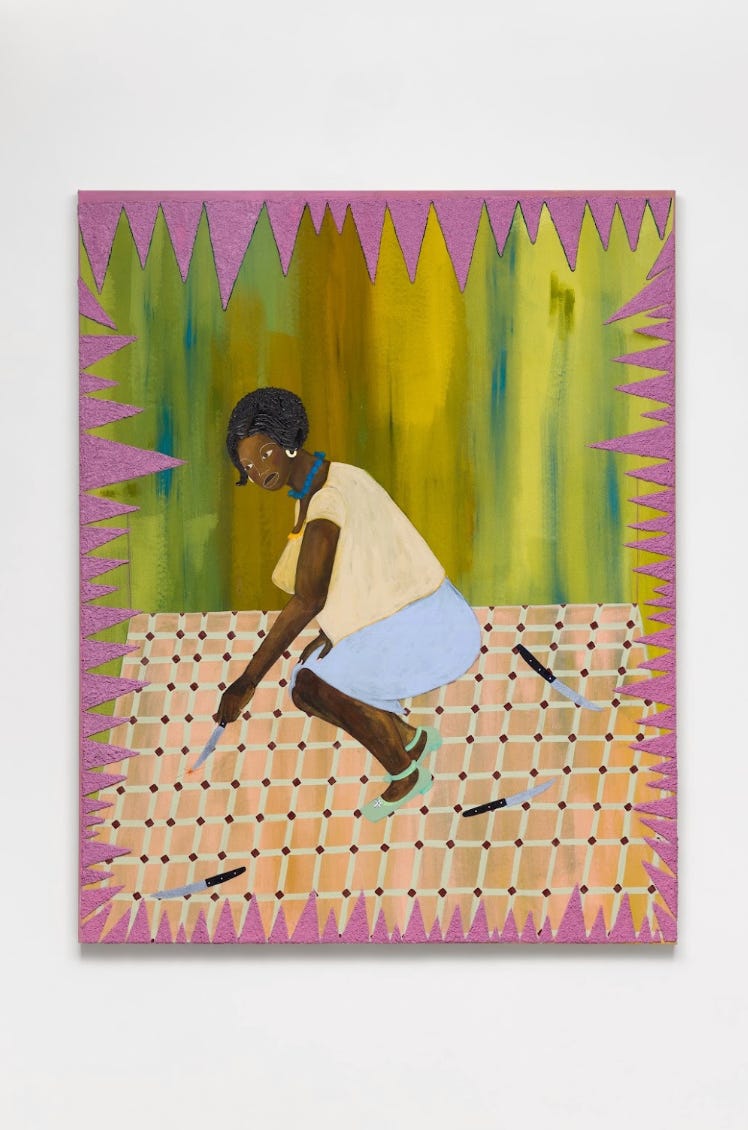
LS: Some of the female figures in my work are based on references from my family, but lately I’ve been bringing in questions around feelings, my own feelings, that don’t necessarily need to be represented through a literal self-portrait. I think this happens because these feelings and experiences are not uniquely mine. I don’t usually sketch, so these figures emerge through the process of painting.
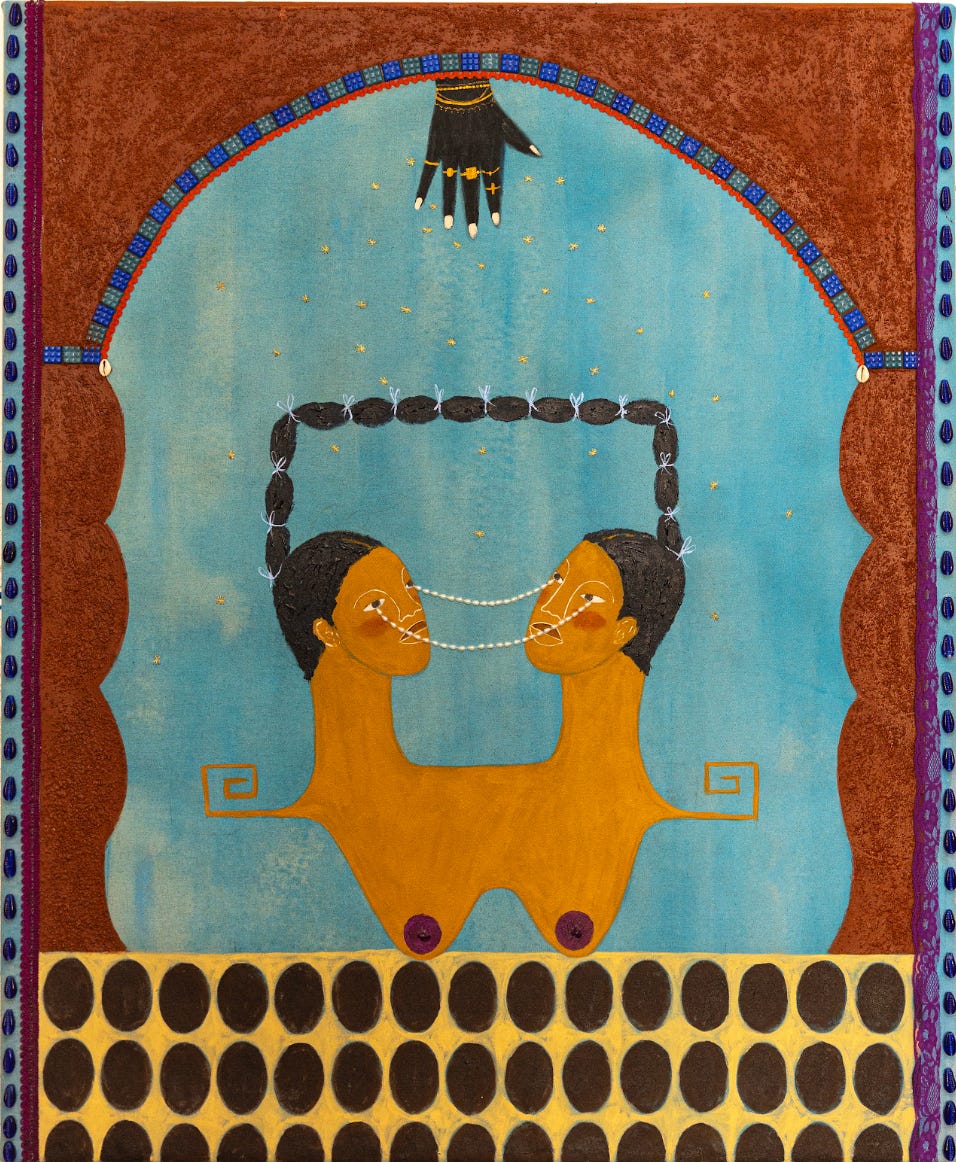
Your work brings painting into dialogue with fabric, embroidery, shells, resin, and found materials. How does materiality shape the way you build meaning in your practice?
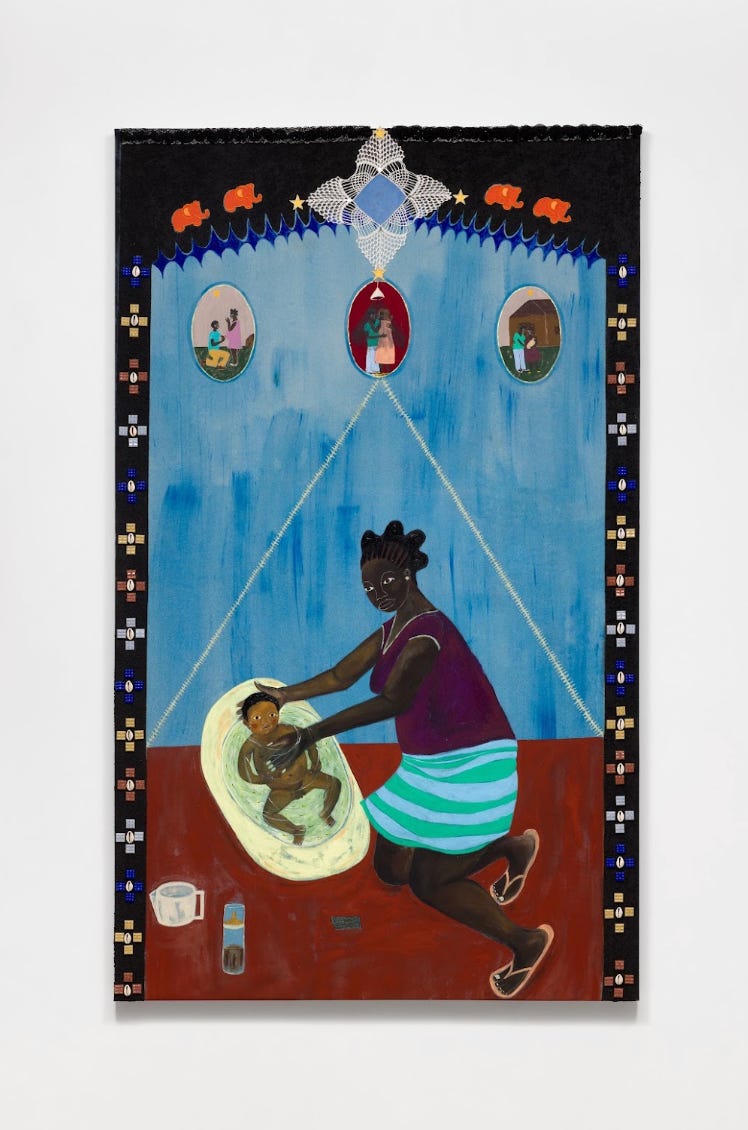
LS: Some of these materials, such as fabric, remind me of the domestic environment. Since some of my paintings speak about this environment, I believe materiality can connect with the subject. The technique of assemblage emerged in my work in a timid and curious way. Three-dimensional materials and embroidery showed me a beautiful and magical way of composing alongside painting.
“Some of these materials, such as fabric, remind me of the domestic environment. Since some of my paintings speak about this environment, I believe materiality can connect with the subject.”
Spirituality has become increasingly present in your recent work. How has this dimension of your practice evolved, particularly in the way your paintings move between the everyday and the sacred?
LS: I think bringing spirituality into my painting is as natural as eating. It is part of my universe, of what I believe in and practice. Talking about the spirituality present in our everyday lives is also about believing that there is something beyond this life and that we are not alone.
“I think bringing spirituality into my painting is as natural as eating. It is part of my universe, of what I believe in and practice.”
Your research has increasingly connected Brazil with other parts of the African diaspora, particularly Angola. How have those encounters changed the way you think about ancestry and your own practice?
LS: Going to Angola was one of the most incredible experiences of my life. There, I learned even more about how deeply Bantu culture is present in Brazil, even in our language. I also learned that many of us carry an image of Africa in our minds—an imagined, mythical Africa—and that we need to deconstruct many of the ideas and assumptions we hold.
During my residency at Angola Air, I was able to listen to many artists and meet people from different walks of life. Hearing their stories inspired me. The year after the residency, I returned to Luanda on my own. I wanted to research popular beliefs there without going deeply into any specific religion. I then created a series of paintings called Fé Feitiço, in which I brought together Brazilian and Angolan beliefs, giving voice to what we learn through oral tradition and reflecting on how much of this knowledge we are losing with the advancement of modernity and globalization.
What I brought into my practice is more about the process of being attentive to feeling, listening, and experience. In the end, these things can be very important to artistic creativity.
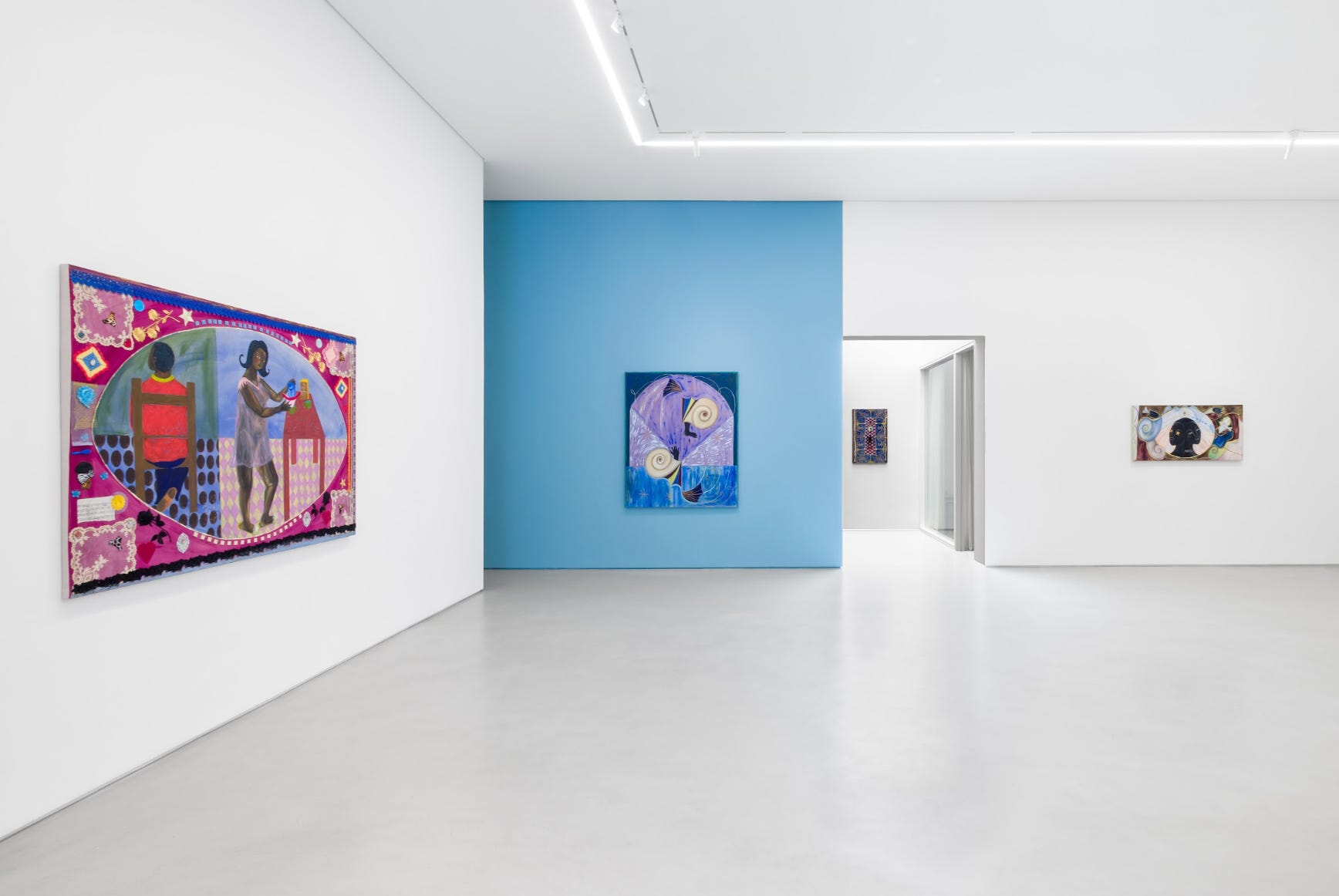
At this stage in your practice, what ideas or questions are you most interested in exploring next?
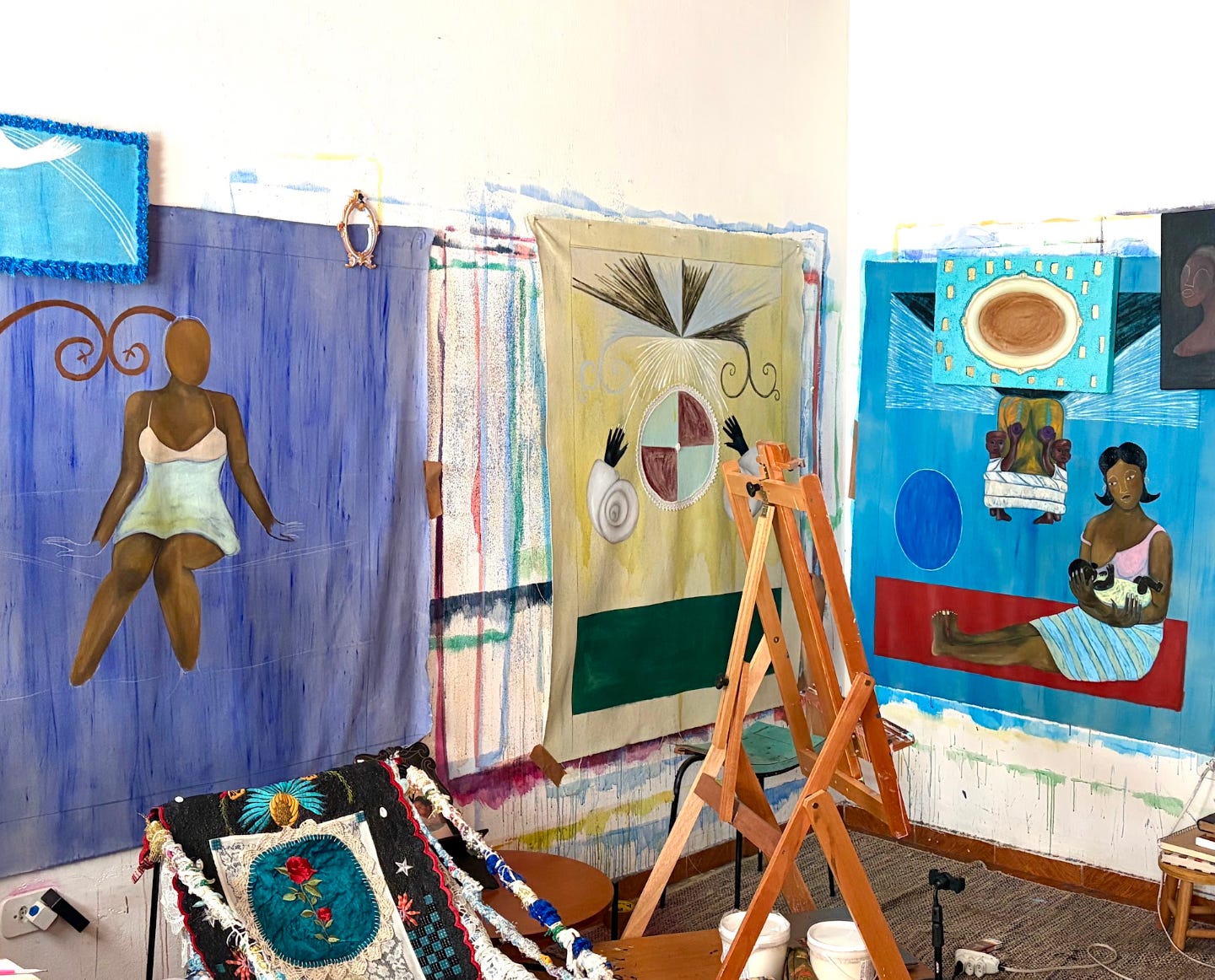
LS: I’ve always liked experimenting with new things in my paintings. Usually, I would do this without having much time: I would experiment within works that I already needed to finish and deliver. It was a little risky, but it was also interesting. Now, I’ve decided to take a break from deadlines so that I can dedicate myself to experimenting with different practices. I’ve become even more interested in Surrealism, oil painting, and ceramic sculpture.
To learn more about Larissa de Souza, visit:
En el estudio con: Larissa de Souza
Larissa de Souza es una artista brasileña cuya práctica reúne pintura, ensamblaje, memoria y espiritualidad. A partir de historias familiares y de su experiencia como mujer afrobrasileña, explora la relación entre lo íntimo y lo colectivo a través de composiciones profundamente materiales.
En esta conversación con Art in Latin America, de Souza habla de su formación autodidacta, la presencia de la ancestralidad y la espiritualidad en su obra, su investigación en Angola y las nuevas direcciones de su práctica.

¡Acompáñanos en Londres el próximo mes! Los miembros pagos de Art in Latin America reciben invitaciones VIP a ferias de arte seleccionadas, incluyendo Paraíso. Actualiza tu membresía aquí para recibir la tuya.
Has hablado de cómo descubriste el arte a pesar de haber tenido un acceso limitado a él durante tu infancia. ¿De qué manera esos primeros encuentros marcaron tu camino hacia la pintura?
LS: Creo que el arte llegó a mí a través de la imaginación. Aunque mi infancia estuvo marcada por problemáticas sociales, yo creaba un mundo distinto a través de mi imaginación. A medida que crecemos, buscamos otras formas de expresarnos y de seguir avanzando en la vida. El arte se convirtió para mí en una manera de seguir accediendo a ese lugar que, hasta entonces, había permanecido en mi infancia.
Durante mi preadolescencia, descubrí los grafitis y murales de la ciudad mientras caminaba con mi madre o mi abuela. El arte urbano es muy democrático, y fue a través de él que entendí que quería ser artista. Utilizaba cualquier material que pudiera ofrecerme color: esmalte de uñas, carbón, maquillaje, sombra de ojos, entre otros. Cuando pintaba, sentía que estaba creando un universo diferente para mí. Incluso pintaba las paredes de mi casa.
Empecé a trabajar desde muy joven para ayudar a mi familia. Entre 2016 y 2021, trabajé como vendedora y después como asistente de arte en una tienda de materiales artísticos en São Paulo. Siempre digo que ese lugar fue mi universidad. Allí aprendí sobre distintos materiales y técnicas, y conocí a muchos artistas. Fue también allí donde empecé a pintar sobre lienzo y a experimentar con diferentes técnicas.
Eres una artista autodidacta. ¿Cómo fue para ti ese proceso de aprender de manera independiente?
LS: Aprendí de mi familia a “arreglármelas con lo que tengo”, así que ser autodidacta siempre me resultó algo natural. Para mí significó pintar sin miedo a equivocarme, experimentar y, a través de ese proceso, entender qué me gustaba o no del resultado. También implicó aprender mediante la práctica y saber dónde y cuándo detenerme.
¿Crees que no haber tenido una formación académica formal te dio cierta libertad para desarrollar tus propios métodos y tu propio vocabulario visual?
LS: Creo que la formación académica tiene su importancia, pero pienso que, si hubiera tenido la oportunidad de estudiar arte antes de empezar a trabajar como artista, mi lenguaje visual sería diferente.
Gran parte de tu trabajo parte de tu experiencia como mujer afrobrasileña, pero también parece que la pintura se ha convertido en una forma de volver la mirada hacia tu familia y las historias que te han moldeado. ¿Cómo ha cambiado tu comprensión de tu propia identidad a través de la práctica artística?
LS: Aprendo mucho a través de la pintura; para mí es casi una forma de autoanálisis. Aunque gran parte de mi trabajo surge de un lugar subjetivo, también tiene una dimensión colectiva. Veo que muchas mujeres se identifican con lo que presento a través de mi obra.
Estoy muy agradecida por lo que hago. Trabajar con arte me ha enseñado a comprender el sistema en el que vivimos y me ha ayudado a romper ciclos que parecían estar predeterminados para mí. Hoy me siento más consciente y segura de que puedo llegar lejos.
“Aprendo mucho a través de la pintura; para mí es casi una forma de autoanálisis. Aunque gran parte de mi trabajo surge de un lugar subjetivo, también tiene una dimensión colectiva. Veo que muchas mujeres se identifican con lo que presento a través de mi obra.”
Las mujeres ocupan un lugar central en gran parte de tu obra. ¿Quiénes son estas figuras y cómo piensas a las mujeres que eliges representar?
LS: Algunas de las figuras femeninas de mi obra parten de referencias de mi propia familia, pero últimamente he empezado a incorporar cuestiones relacionadas con los sentimientos, con mis propios sentimientos, que no necesariamente tienen que representarse mediante un autorretrato literal. Creo que esto sucede porque esos sentimientos y experiencias no son exclusivamente míos. No suelo hacer bocetos, así que estas figuras aparecen durante el propio proceso de pintar.
Tu trabajo pone la pintura en diálogo con telas, bordados, conchas, resina y objetos encontrados. ¿Cómo influye la materialidad en la manera en que construyes significado dentro de tu práctica?
LS: Algunos de estos materiales, como la tela, me remiten al entorno doméstico. Como algunas de mis pinturas hablan de ese espacio, creo que la materialidad puede establecer una conexión con el tema. La técnica del assemblage apareció en mi obra de una manera tímida y curiosa. Los materiales tridimensionales y el bordado me mostraron una forma bella y mágica de componer junto con la pintura.
“Algunos de estos materiales, como la tela, me remiten al entorno doméstico. Como algunas de mis pinturas hablan de ese espacio, creo que la materialidad puede establecer una conexión con el tema.”
La espiritualidad se ha vuelto cada vez más presente en tu obra reciente. ¿Cómo ha evolucionado esta dimensión de tu práctica, especialmente en la manera en que tus pinturas se mueven entre lo cotidiano y lo sagrado?
LS: Creo que llevar la espiritualidad a mi pintura es tan natural como comer. Forma parte de mi universo, de aquello en lo que creo y practico. Hablar de la espiritualidad presente en nuestra vida cotidiana también tiene que ver con creer que existe algo más allá de esta vida y que no estamos solos.
“Creo que llevar la espiritualidad a mi pintura es tan natural como comer. Forma parte de mi universo, de aquello en lo que creo y practico.”
Tu investigación ha conectado cada vez más a Brasil con otras partes de la diáspora africana, especialmente Angola. ¿Cómo han cambiado esos encuentros tu forma de pensar la ancestralidad y tu propia práctica?
LS: Viajar a Angola fue una de las experiencias más increíbles de mi vida. Allí aprendí aún más sobre la profunda presencia de la cultura bantú en Brasil, incluso en nuestro idioma. También comprendí que muchos de nosotros llevamos en la mente una determinada imagen de África —una África imaginada, mítica— y que necesitamos deconstruir muchas de las ideas y suposiciones que arrastramos.
Durante mi residencia en Angola Air, pude escuchar a muchos artistas y conocer a personas de distintos ámbitos. Escuchar sus historias me inspiró. Al año siguiente de la residencia, regresé sola a Luanda. Quería investigar las creencias populares de allí sin adentrarme demasiado en ninguna religión específica. Después creé una serie de pinturas titulada Fé Feitiço, en la que reuní creencias brasileñas y angoleñas, dando voz a aquello que aprendemos a través de la tradición oral y reflexionando sobre cuánto de ese conocimiento estamos perdiendo con el avance de la modernidad y la globalización.
Lo que incorporé a mi práctica tiene más que ver con el proceso de prestar atención a los sentimientos, a la escucha y a la experiencia. Al final, todo esto puede ser muy importante para la creatividad artística.
En esta etapa de tu práctica, ¿qué ideas, materiales o preguntas te interesa explorar a continuación?
LS: Siempre me ha gustado experimentar con cosas nuevas en mis pinturas. Por lo general, lo hacía sin disponer de mucho tiempo: experimentaba dentro de obras que ya tenía que terminar y entregar. Era un poco arriesgado, pero también interesante. Ahora he decidido tomarme una pausa de los plazos de entrega para poder dedicarme a experimentar con distintas prácticas. Me he interesado aún más por el Surrealismo, la pintura al óleo y la escultura en cerámica.
Para conocer más sobre Larissa de Souza, visita: