


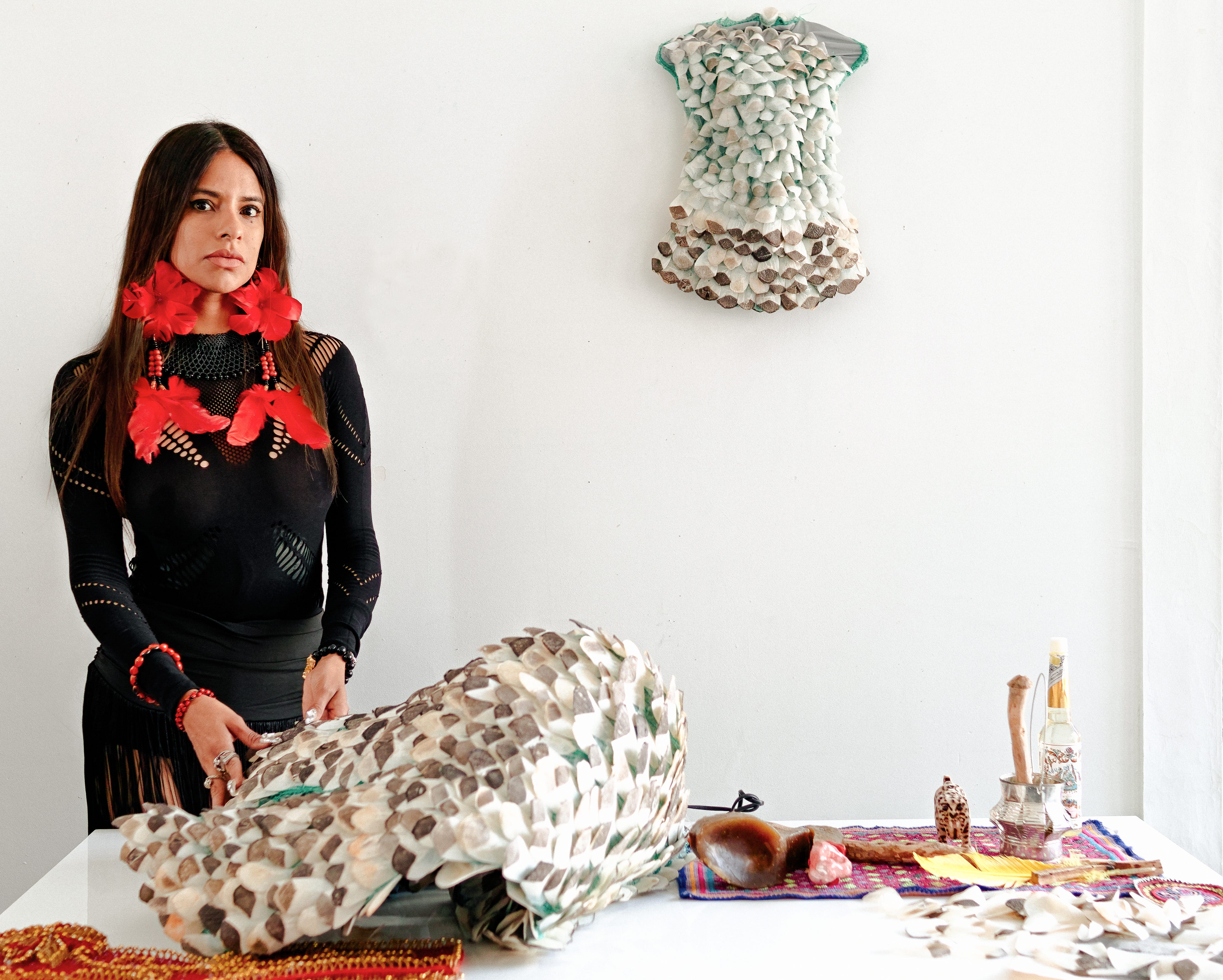
Kay Zevallos Villegas is a performance artist whose practice extends into sculpture and installation, rooted in the body as a living territory shaped by ancestral knowledge, memory, and environment. Drawing on her Andean-Quechua heritage and upbringing in the Peruvian Amazon, her work emerges from ritual and collective forms of knowing.
In this conversation, Kay reflects on inherited knowledge, extractivist histories, migration, and collaboration with women and migrant communities, while also discussing her upcoming performance at the Thyssen Museum, where she engages critically with colonial art histories through a dialogue with Paul Gauguin’s work.
Your work moves between performance, sculpture, and installation, although performance seems to occupy a central place. How did your interest in that language begin? Was it your starting point as an artist, or did you arrive at it through other media?
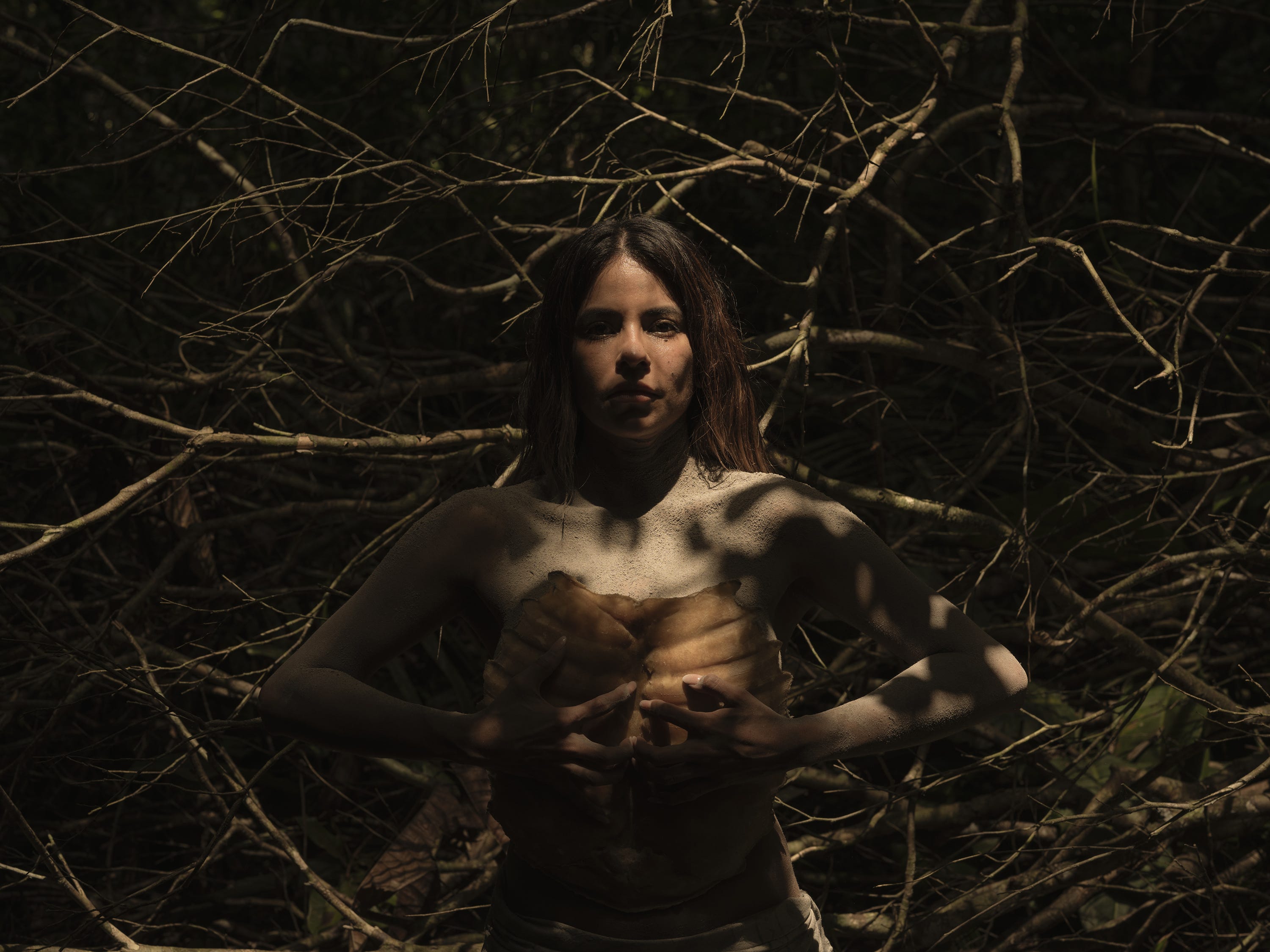
KZ: For me, the body is a territory that is constructed through the memories and knowledge of our ancestors, the environment, and lived experience. In my practice, performance does not appear as a medium in itself, but as a dialogue with that living territory.
My approach does not come from an academic tradition of contemporary art, but from my Andean-Quechua heritage and, above all, from having grown up in the Peruvian Amazon, where gesture, myth, transformation, and the relationship with that which lies beyond the visible are part of everyday life. I began dancing as a child, with the traditional dances of my region, but over time I understood that these movements were not only choreographic, but also carriers of memory and transmission.
Performance becomes a threshold where the body is not seen as an individual entity, but as collective, ancestral, and capable of imagining other forms of life. Sculpture, image, and installation emerge as traces or extensions of that event, as part of a ritual that does not end in its execution, but continues to dialogue with matter, which in turn becomes body.
"Performance becomes a threshold where the body is not seen as an individual entity, but as collective, ancestral, and capable of imagining other forms of life.”
You grew up in Iquitos, in the urban Peruvian Amazon. In what ways has that environment shaped your practice? How does your work engage with the knowledge, memories, and ways of relating to the world that you inherited?
KZ: I was born in Lima, but that is, in a way, an administrative matter: I arrived in Iquitos very young. It was there that I learned to relate to the world, where my consciousness was formed, and where everything began.
I am the granddaughter and daughter of Quechua women, and my grandparents also come from the highlands of Peru. That Andean heritage was always present in my family environment, although my immediate world was the Amazonian lowlands. The Andean and the Amazonian coexisted organically at home: in gestures, in practices, and in the way of understanding life.
This inherited knowledge is the foundation of my work: knowledge of plants, my grandmother’s reading of coca leaves, natural dyes, collective and domestic rituals, Andean spirituality, and its cosmovisions. To this is added a memory built in direct relation to the territory where I grew up and, above all, with women: women from my city and from the Indigenous communities of my territory.
In this intersection of inheritances, displacements, and shared experiences, my practice takes shape. My work does not seek to represent that origin, but to activate it, to tension it, and to bring it into dialogue with my own lived experiences, which over time I understood are not individual, but deeply collective and ancestral.
In your practice you work with organic materials, collected elements, and often collaborative processes. What do you seek to activate through these materials and working dynamics? What does it mean for you to collaborate with other women and with migrant communities?
KZ: As a child, I grew up knowing that a tree is not only wood, leaves, and fruit; that fish are not only food; and that the river is not merely water. For me, the organic is not only matter, but also spirit and memory. What for some are waste, for us are lives.
Iquitos is marked by cycles of extractivism that have torn from the land forms of knowledge, practices, and ways of relating to the world. This process has affected not only living beings, but also their meanings, stripping materials of their collective and ritual dimension.
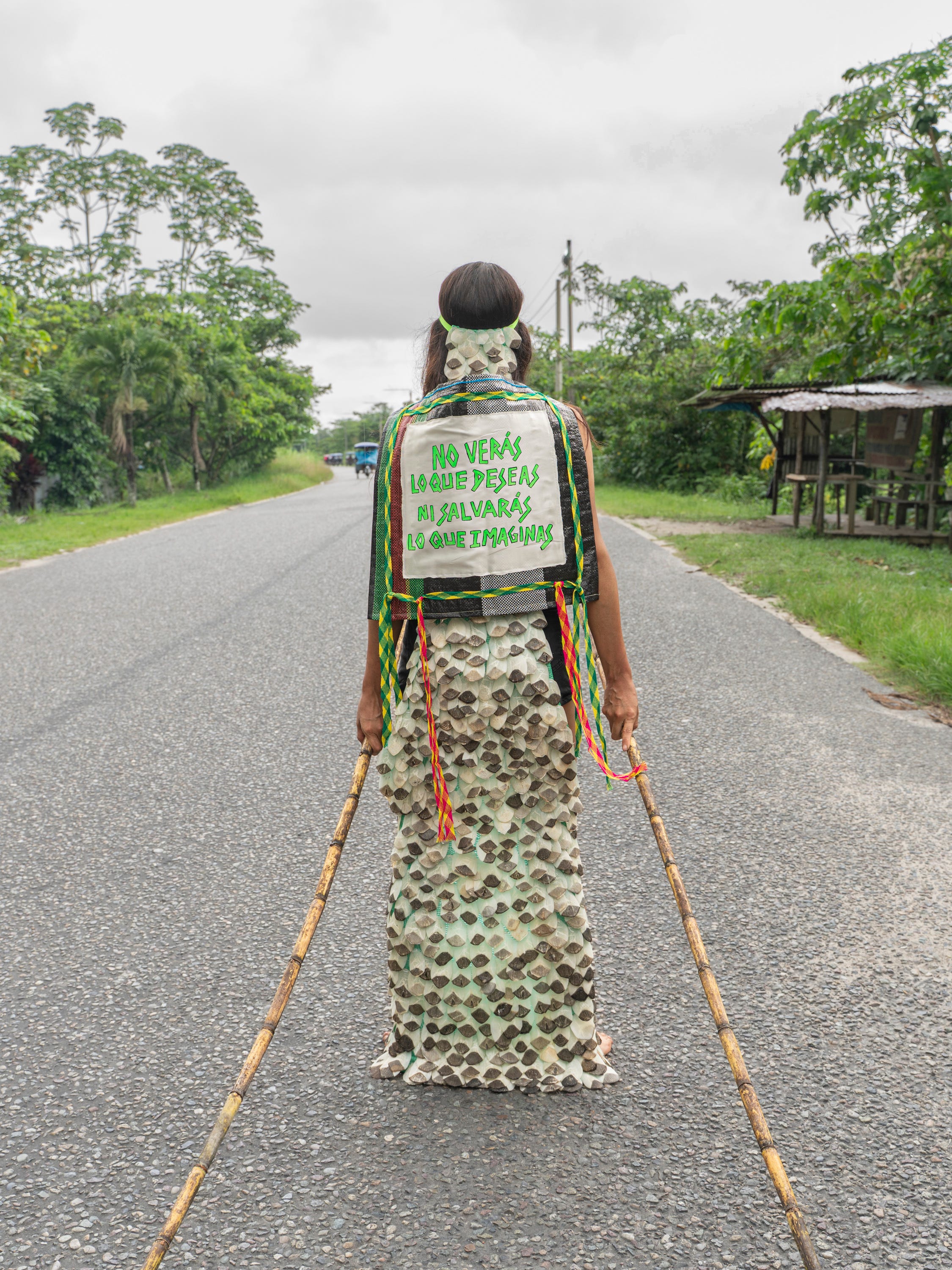
When I left my territory, I understood that materials such as rubber, coca leaves, or fish scales circulate within colonial logics that have fragmented the histories from which they come. My work seeks for these materials to speak again from their origins, recovering their living, symbolic, and political dimension.
Inviting women and migrant communities into my performances is a way of recognizing that these stories are not mine alone. It is an insistence that knowledge is collective. Working with industrial latex, for example, implies confronting the extractive history of rubber; working with scales means restoring value to what has been discarded and reactivating its transformative potential.
"Inviting women and migrant communities into my performances is a way of recognizing that these stories are not mine alone. It is an insistence that knowledge is collective.”
How does the work transform when it is no longer only your body that embodies it?
KZ: No body embodies itself alone. My body is an accumulation of other bodies, of genealogies that inhabit it; of inherited fears and guilt, but also of knowledge and resistance. The body absorbs, transforms, and mimics, but it never ceases to be a space where the collective persists.
That is why I think of my work as something that does not belong solely to my body, but as a body traversed by many others that expand it. My body is a point of passage, not a limit.
When other bodies enter the work, they do not complete it: they displace it. It is in that intersection that it gains real strength, where the gesture ceases to be seen as one’s own and becomes shared, and where the experience multiplies and is re-signified.
The figure of the grandmother and mother appears as an important axis in your work. What kind of knowledge or force do you find in that feminine genealogy?
KZ: My maternal grandmother, a Quechua speaker, was a reader of coca leaves in her community and a food vendor in the market. My paternal grandmother, also Andean, migrated to the capital and worked in domestic service, carrying her son in her womb—my father.
My mother embodies endless stories in which the market as a workspace, internal migration as an imposed condition, and everyday ritual spirituality form an essential part of her life, of my memories with her, and of my own existence. These women are my seeds. I have been formed in the compost of their memories.
In my body I carry not only their trajectories and struggles, but also their questions, their silences, and their ways of sustaining life. To speak of myself is to speak of them. What begins as an intimate and familial story expands toward the feminine. My work emerges from that living genealogy where the feminine is not only a theme, but a structural force, a form of knowledge, and of resistance.
“My work emerges from that living genealogy where the feminine is not only a theme, but a structural force, a form of knowledge, and of resistance.”
Your migratory experience runs deeply through your practice. How has it influenced your way of thinking about the body, identity, and displacement?
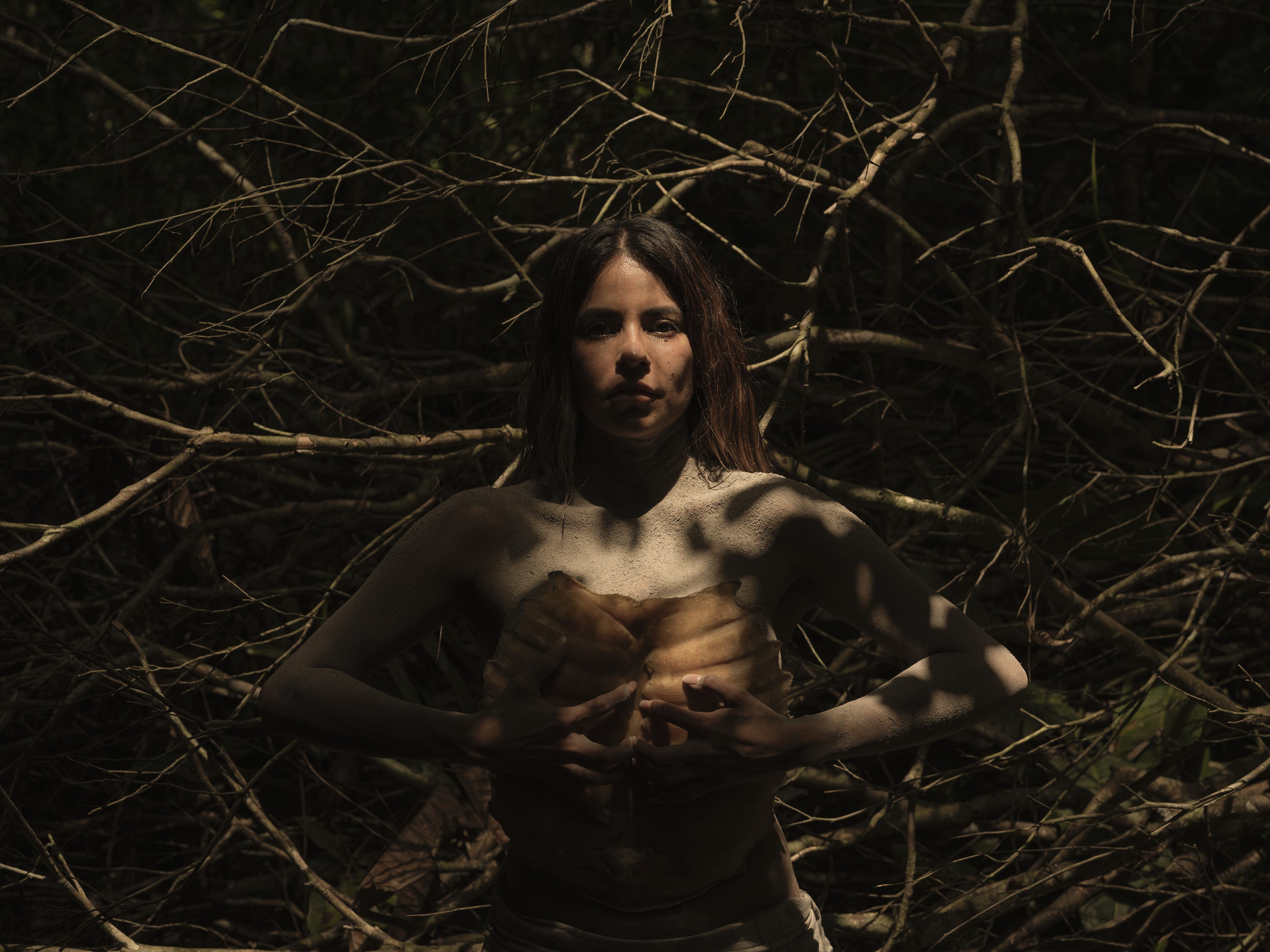
KZ: The migratory experience runs through my practice in multiple layers: from the migrations of my ancestors, often forced by violence and inequality, to the one I myself have embodied, also shaped by a context that restricted my ways of inhabiting and existing. Migration implies constant reconfiguration, like a body shedding its skin; each context leaves marks that remain in tension within the body.
In my work, migration is not only a theme, but a structural condition. It appears as trace and fracture, but also as potential. I am interested in thinking about the migrant body not only from uprootedness, but as a body that carries memories, translates territories, and generates new forms of relation and meaning. My practice is situated in that in-between: between what is left behind, what is carried, and what is transformed.
Your performances often activate the sensory (sound, touch, smell) as a fundamental part of the experience. How do you think about the relationship with the viewer from that perspective? Are you interested in provoking a specific reaction or opening a more sensory and intuitive space?
KZ: When I carried out my first actions in my territory, I did not understand them as performance within contemporary art; they emerged from rituals I shared with my mother, where the body, gesture, sound, and environment were deeply intertwined. Although I now engage with more formalized languages of contemporary art, the root of my practice remains sensory, ritual, and relational.
I do not seek to provoke a specific reaction or to direct a closed reading, but to open a space where each body, human or not, enters into relation with the experience. When people speak of “spectators,” I do not refer only to people, but also to the earth, plants, rivers, and elements that perceive and transform the action. Therefore, they cease to be mere observers of the action and become part of it. The work is completed within that network of sensitive relations where everything present participates.
“When I carried out my first actions in my territory, I did not understand them as performance within contemporary art; they emerged from rituals I shared with my mother, where the body, gesture, sound, and environment were deeply intertwined.”
In May you will present a performance at the Thyssen Museum, in dialogue with a painting by Gauguin. How did this project come about, and what are you interested in bringing into play in this encounter between your practice and that work?
KZ: Pri-mitiva: como planta a la tierra arises from the need to reclaim the word “primitive,” not from its colonial charge, but from its primary and vital meaning. I am interested in thinking of the primitive as that which sustains life: the seed, the compost, the root. Because before the root there is the seed, and before the seed, the matter that nourishes it.
The work enters into dialogue with Gauguin through friction. For me, Gauguin is not the center; to some extent, that role belongs to Flora Tristán, his grandmother. Starting from Mata Mua, I imagine the invisible genealogies behind those images: women represented through a colonial, exoticized, and violent gaze. The performance proposes to displace that gaze, to speak from those women and not about them; from the grandmother and not from the painter. And in displacing him, I also confront him.
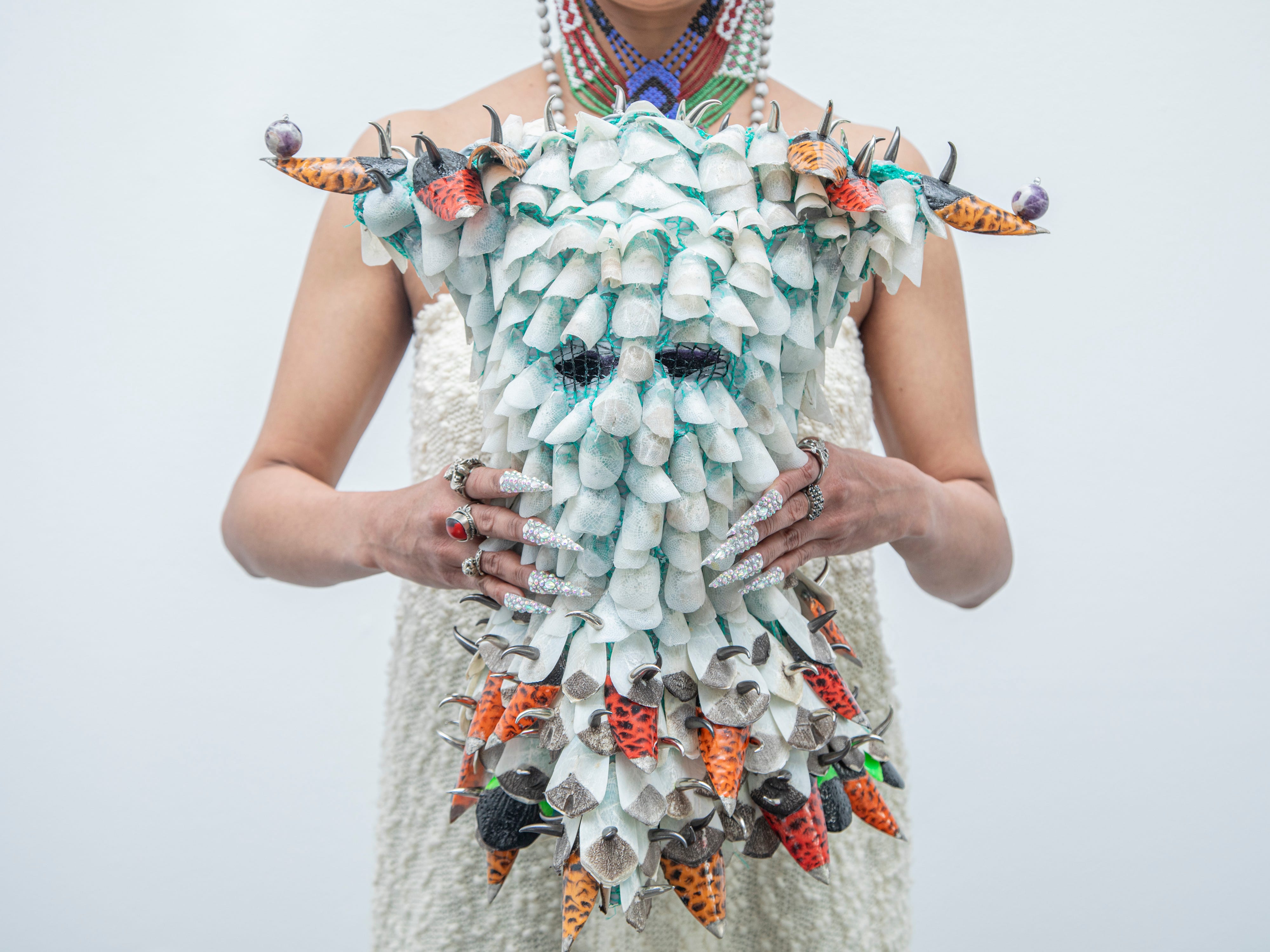
This action has been developed as a weaving of memories. The scales that accompany the masks were pishtadas—the action of removing scales from the skin of the fish—with women from my territory, and were worked on together with the LGBTQ+ community of my city, with whom I actively participate as a drag queen. Later, these pieces will be worn by the migrant drag community in Madrid—drags of Peruvian and Bolivian origin—who will incorporate their own stories in dialogue with these materials and with the memories that the Atlantic has carried.
The work opens a chain of the feminine that crosses territories, times, and bodies, and it erupts into a museum space like the Thyssen, where works have historically been exhibited through colonial logics and where these bodies have been more objects of representation than presences.
Primitiva como planta en la tierra is an eruption. I do not recognize any center. Everything is transit, transformation, and collective construction. In that becoming, every body is multiple, every body is drag.
In the new performance that I will present at the Thyssen this May 13, the river enters the museum through its skins. The scales, worked by women’s hands, condense memory, labor, and relationship with the territory. Cumbia erupts into a space historically associated with silent contemplation. Drag appears as a form of transformation, resistance, and community.
To learn more about Kay Zevallos Villegas, visit:
En el estudio con: Kay Zevallos Villegas
Kay Zevallos Villegas es una artista de performance cuya práctica se extiende hacia la escultura y la instalación, arraigada en el cuerpo como un territorio vivo moldeado por saberes ancestrales, la memoria y el entorno. A partir de su herencia andina-quechua y de su crianza en la Amazonía peruana, su trabajo surge desde lo ritual y formas colectivas de conocimiento.
En esta conversación, Kay reflexiona sobre los saberes heredados, las historias de extractivismo, la migración y la colaboración con mujeres y comunidades migrantes, al tiempo que aborda su próxima performance en el Museo Thyssen, donde entabla un diálogo crítico con las narrativas coloniales de la historia del arte a partir de la obra de Paul Gauguin.
Tu trabajo se mueve entre performance, escultura e instalación, aunque la performance parece ocupar un lugar central. ¿Cómo empezó tu interés por ese lenguaje? ¿Fue tu punto de partida como artista o llegaste a él desde otros medios?
KZ: Para mí, el cuerpo es un territorio que se construye con las memorias y saberes de nuestrxs ancestrxs, del entorno y de las propias vivencias. En mi práctica, la performance no aparece como un medio en sí mismo, sino como un diálogo con ese territorio vivo.
Mi acercamiento no proviene de una tradición académica del arte contemporáneo, sino de mi herencia andina-quechua y, sobre todo, de haber crecido en la Amazonía peruana, donde el gesto, el mito, la transformación y la relación con aquello que está más allá de lo visible forman parte de la vida cotidiana. Comencé con el baile desde niña, con las danzas tradicionales de mi región, pero con el tiempo entendí que esos movimientos no eran solo coreográficos, sino también portadores de memoria y transmisión.
La performance se convierte en un umbral donde el cuerpo no es visto como ente individual, sino colectivo, ancestral y capaz de imaginar otras formas de vida. La escultura, la imagen y la instalación emergen como huellas o extensiones de ese acontecimiento, como parte de un ritual que no termina en su ejecución, sino que continúa dialogando con la materia, que a su vez se vuelve cuerpo.
“La performance se convierte en un umbral donde el cuerpo no es visto como ente individual, sino colectivo, ancestral y capaz de imaginar otras formas de vida.”
Creciste en Iquitos, en la Amazonía urbana peruana. ¿De qué manera ese entorno ha marcado tu práctica? ¿Cómo dialoga tu obra con los saberes, memorias y formas de relación con el mundo que heredaste?
KZ: Nací en Lima, pero eso es, en cierto modo, una cuestión administrativa: llegué a Iquitos muy pequeña. Fue allí donde aprendí a relacionarme con el mundo, donde se formó mi conciencia y donde comenzó todo.
Soy nieta e hija de mujeres quechuas, y mis abuelos provienen también de la sierra del Perú. Esa herencia andina estuvo siempre presente en mi entorno familiar, aunque mi mundo inmediato era la llanura amazónica. Lo andino y amazónico convivían de manera orgánica en casa: en los gestos, en las prácticas y en la forma de entender la vida.
Esos saberes heredados son la base de mi trabajo: el conocimiento de las plantas, la lectura de hojas de coca de mi abuela, los tintes naturales, los rituales colectivos y domésticos, la espiritualidad andina y sus cosmovisiones. A esto se suma una memoria construida en relación directa con el territorio que me vio crecer y, sobre todo, con las mujeres: mujeres de mi ciudad y de los pueblos originarios de mi territorio.
En ese cruce de herencias, desplazamientos y experiencias compartidas se configura mi práctica. Mi obra no busca representar ese origen, sino activarlo, tensionarlo y hacerlo dialogar con mis propias vivencias, que con el tiempo entendí que no son individuales, sino profundamente colectivas y ancestrales.
En tu práctica trabajas con materiales orgánicos, elementos recolectados y procesos muchas veces colaborativos. ¿Qué buscas activar a través de esos materiales y esas dinámicas de trabajo? ¿Qué significa para ti colaborar con otras mujeres y con comunidades migrantes?
KZ: De niña crecí sabiendo que un árbol no es solo madera, hojas y frutos; que los peces no son solo alimento, y que el río no es únicamente agua. Lo orgánico, para mí, no es solo materia, sino también espíritu y memoria. Lo que para algunxs son desechos, para nosotres son vidas.
Iquitos está atravesada por ciclos de extractivismo que han arrancado de la tierra saberes, prácticas y formas de relación con el mundo. Ese proceso ha afectado no solo a lo vivo, sino también a sus significados, despojando a las materias de su dimensión colectiva y ritual.
Al salir de mi territorio entendí que materias como el caucho, la hoja de coca o las escamas circulan dentro de lógicas coloniales que han fragmentado las historias de donde provienen. Mi trabajo busca que esas materias vuelvan a hablar desde sus orígenes, recuperando su dimensión viva, simbólica y política.
Invitar a mujeres y comunidades migrantes en mis performances es reconocer que estas historias no son solo mías. Es insistir en que el conocimiento es colectivo. Trabajar con látex industrial, por ejemplo, implica confrontar la historia extractiva del caucho; trabajar con escamas, devolver valor a aquello que ha sido descartado y reactivar su potencia transformadora.
"Invitar a mujeres y comunidades migrantes en mis performances es reconocer que estas historias no son solo mías. Es insistir en que el conocimiento es colectivo."
¿Cómo se transforma la obra cuando ya no es solo tu cuerpo el que la encarna?
KZ: Ningún cuerpo se encarna solo. Mi cuerpo es un cúmulo de otros cuerpos, de genealogías que habitan en él; de miedos y culpas heredadas, pero también de saberes y resistencias. El cuerpo absorbe, se transforma, se mimetiza, pero nunca deja de ser un espacio donde lo colectivo insiste.
Por eso, pienso mi obra como algo que no pertenece únicamente a mi cuerpo, sino como un cuerpo atravesado por muchos otros que lo expanden. Mi cuerpo es un punto de tránsito, no un límite.
Cuando otros cuerpos entran en la obra, no la completan: la desplazan. Es en ese cruce donde cobra verdadera fuerza, donde el gesto deja de ser visto como propio para volverse compartido, y donde la experiencia se multiplica y se resignifica.
La figura de la abuela y mamá aparecen como un eje importante en tu trabajo. ¿Qué tipo de conocimiento, memoria o fuerza encuentras en esa genealogía femenina?
KZ: Mi abuela materna, quechua-hablante, era lectora de hojas de coca en su comunidad y vendedora de comida en el mercado. Mi abuela paterna, también andina, migró a la capital y se empleó en el servicio doméstico, llevando consigo a su hijo en el vientre, mi padre.
Mi madre encarna historias interminables donde el mercado como espacio de trabajo, la migración interna como condición impuesta y la espiritualidad ritual cotidiana forman parte esencial de su vida, de mis recuerdos con ella y de mi propia existencia. Estas mujeres son mis semillas. Me he formado en el abono de sus memorias.
En mi cuerpo cargo no solo sus trayectorias y luchas, sino también sus preguntas, sus silencios y sus formas de sostener la vida. Hablar de mí es hablar de ellas. Lo que comienza como una historia íntima y familiar se expande hacia lo femenino. Mi trabajo parte desde esa genealogía viva donde lo femenino no es solo un tema, sino una fuerza estructural, una forma de conocimiento y de resistencia.
“Mi trabajo parte desde esa genealogía viva donde lo femenino no es solo un tema, sino una fuerza estructural, una forma de conocimiento y de resistencia.”
Tu experiencia migratoria atraviesa tu práctica de manera muy profunda. ¿Cómo ha influido en tu manera de pensar el cuerpo, la identidad y el desplazamiento?
KZ: La experiencia migratoria atraviesa mi práctica desde múltiples capas: desde las migraciones de mis ancestrxs, muchas veces forzadas por violencia y desigualdad, hasta la que yo misma he encarnado, también condicionada por un contexto que restringía mis formas de habitar y existir. Migrar implica reconfigurarse constantemente, como un cuerpo que muda de piel; cada contexto deja marcas que permanecen en tensión dentro del cuerpo.
En mi trabajo, la migración no es solo un tema, sino una condición estructural. Aparece como huella y fractura, pero también como potencia. Me interesa pensar el cuerpo migrante no solo desde el desarraigo, sino como un cuerpo que porta memorias, traduce territorios y genera nuevas formas de relación y sentido. Mi práctica se sitúa en ese entre: entre lo que se deja, lo que se carga y lo que se transforma.
Tus performances suelen activar lo sensorial (el sonido, el tacto, el olor) como parte fundamental de la experiencia. ¿Cómo piensas la relación con el espectador desde ahí? ¿Te interesa provocar una reacción específica o abrir un espacio más sensorial e intuitivo?
KZ: Cuando realicé mis primeras acciones en mi territorio no las entendía como performance dentro del arte contemporáneo; surgían de los rituales que compartía con mi madre, donde el cuerpo, el gesto, el sonido y el entorno estaban profundamente entrelazados. Aunque hoy dialogue con lenguajes más formalizados del arte contemporáneo, la raíz de mi práctica sigue siendo sensorial, ritual y relacional.
No busco provocar una reacción específica ni dirigir una lectura cerrada, sino abrir un espacio donde cada cuerpo, humano o no, entre en relación con la experiencia. Cuando se habla de “espectadores”, yo no me refiero solo a personas, sino también a la tierra, las plantas, los ríos y los elementos que perciben y transforman la acción. Por lo tanto, dejan de ser solo observadores de la acción, sino parte de ella. La obra se completa en esa red de relaciones sensibles donde todo lo presente participa.
“Cuando realicé mis primeras acciones en mi territorio no las entendía como performance dentro del arte contemporáneo; surgían de los rituales que compartía con mi madre, donde el cuerpo, el gesto, el sonido y el entorno estaban profundamente entrelazados.”
En mayo presentarás una performance en el Museo Thyssen, en diálogo con una pintura de Gauguin. ¿Cómo surgió este proyecto y qué te interesa poner en juego en ese cruce entre tu práctica y esa obra?
KZ: Pri-mitiva: como planta a la tierra parte de la necesidad de reapropiarme de la palabra “primitivo”, no desde su carga colonial, sino desde su sentido primario y vital. Me interesa pensar lo primitivo como aquello que sostiene la vida: la semilla, el abono, la raíz. Porque antes de la raíz está la semilla, y antes de la semilla, la materia que la nutre.
La obra dialoga con Gauguin desde la fricción. Para mí, Gauguin no es el centro; en cierta medida, lo es Flora Tristán, su abuela. A partir de Mata Mua, imagino las genealogías invisibles detrás de esas imágenes: las mujeres representadas desde una mirada colonial, exotizada y violenta. La performance propone desplazar esa mirada, hablar desde esas mujeres y no sobre ellas; desde la abuela y no desde el pintor. Y, al desplazarlo, también lo confronto.
Esta acción se ha gestado como un tejido de memorias. Las escamas que acompañan las máscaras las pishtamos — acción de sacar las escamas de la piel del pescado — con mujeres de mi territorio y fueron trabajadas junto con la comunidad LGBTQ+ de mi ciudad, con la que participo activamente como drag queen. Luego, estas piezas serán portadas por la comunidad drag migrante en Madrid, drags de origen peruano y boliviano, quienes incorporarán sus propias historias en diálogo con esas materias y con las memorias que el Atlántico ha transportado.
La obra abre una cadena de lo femenino que atraviesa territorios, tiempos y cuerpos, e irrumpe en un espacio museal como el Thyssen, donde históricamente se han expuesto obras desde lógicas coloniales y donde estos cuerpos han sido más objeto de representación que presencia.
Primitiva como planta en la tierra es una irrupción. Yo no reconozco ningún centro. Todo es tránsito, transformación y construcción colectiva. En ese devenir, todo cuerpo es múltiple, todo cuerpo es drag.
En la performance inédita que presentaré en el Thyssen este 13 de mayo, el río entra al museo a través de sus pieles. Las escamas, trabajadas por manos de mujeres, condensan memoria, trabajo y relación con el territorio. La cumbia irrumpe en un espacio históricamente asociado a la contemplación silenciosa. El drag se presenta como una forma de transformación, resistencia y comunidad.
Para saber más sobre Kay Zevallos Villegas, visita: